
Trim Size for Puzzle Books: 6×9 vs 8×10 vs 8.5×11
Which KDP trim size suits word search, sudoku, crossword, maze, bingo and coloring books — with letter sizes, printing costs and margins for each.
By Dau Le · · 4 min read
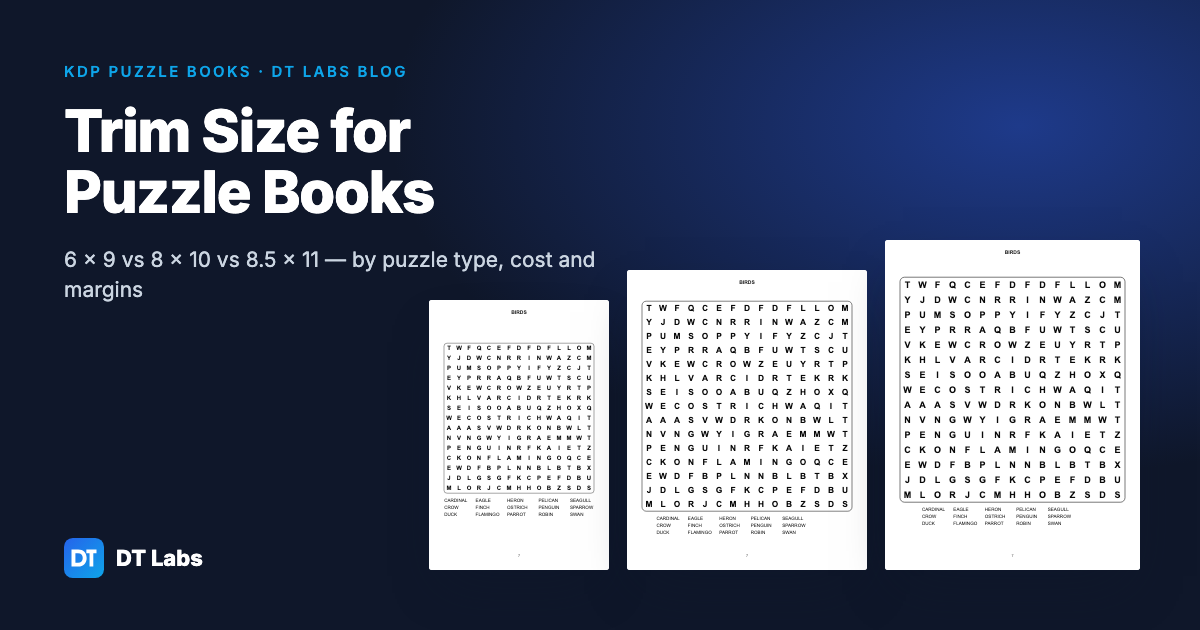
For most puzzle books the choice is between three KDP trim sizes: 6 × 9 in (regular trim, cheapest to print), 8 × 10 in and 8.5 × 11 in (large trim, more room). Use 8.5 × 11 in for large print, children's activity books, coloring books and bingo; use 6 × 9 in for compact adult puzzle books with two or more puzzles per page. This guide shows what each size does to the puzzle on the page, to printing cost and to margins, and which size suits each puzzle type.
In short: a 15 × 15 word search prints at about 14 pt on 6 × 9 in and about 22 pt on 8.5 × 11 in. Large trim costs $0.54 more per copy up to 110 pages and the gap grows with every page after that. Pick the trim for the reader first, then check the cost.
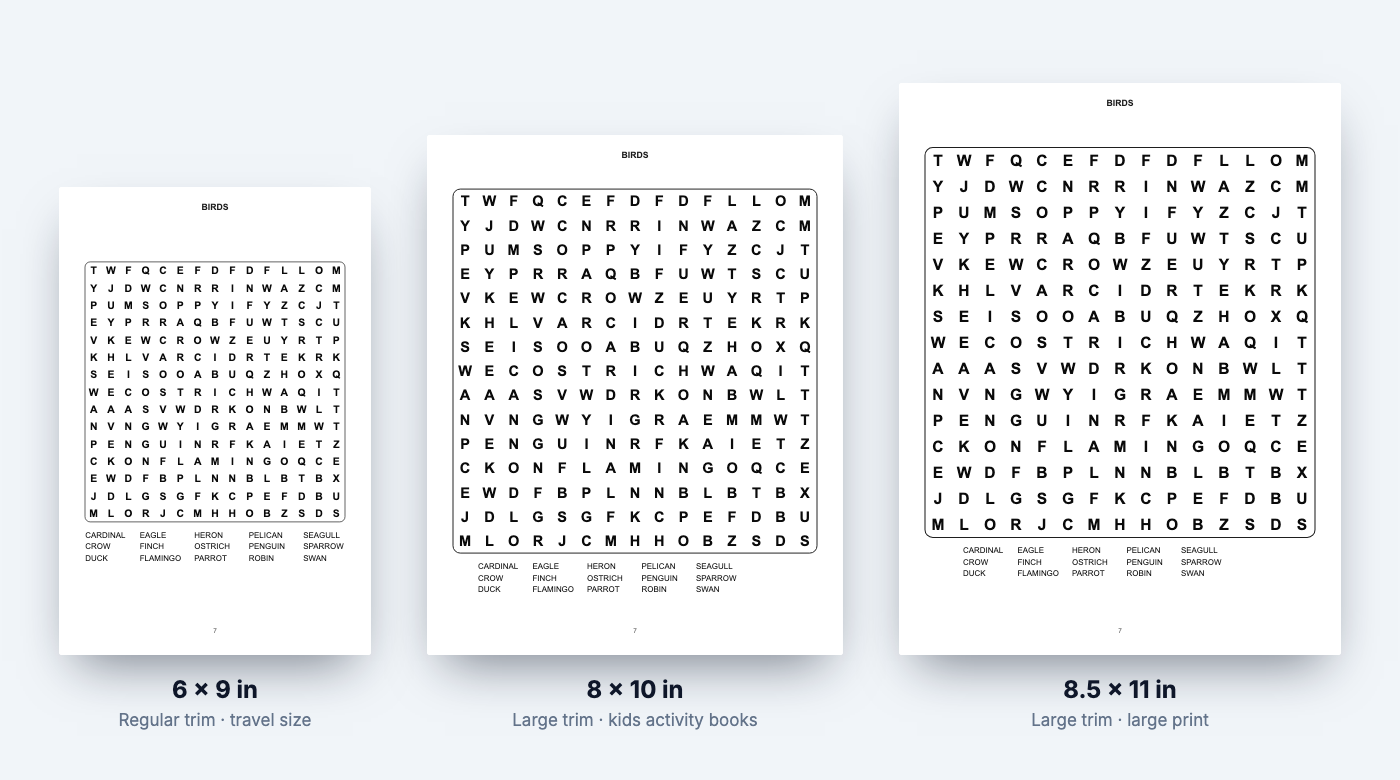
What do 6 × 9, 8 × 10 and 8.5 × 11 look like on the page?
The same puzzle, printed on each trim size at true scale:
| Trim size | KDP class | 15 × 15 grid letters | Feels like |
|---|---|---|---|
| 6 × 9 in | Regular | about 14 pt | A paperback novel; easy to carry |
| 8 × 10 in | Large | about 20 pt | A children's activity book |
| 8.5 × 11 in | Large | about 22 pt | A sheet of printer paper; large print |
The letter sizes are measured from pages made with the DT Labs word search maker. Smaller grids on the same page print bigger: a 12 × 12 grid on 8.5 × 11 in reaches about 27 pt, which is why large print word searches use it.
How much more does a large trim size cost to print?
On Amazon.com, KDP charges by trim class, not by exact size: every trim wider than 6.12 in or taller than 9 in is "large" and costs more per page.
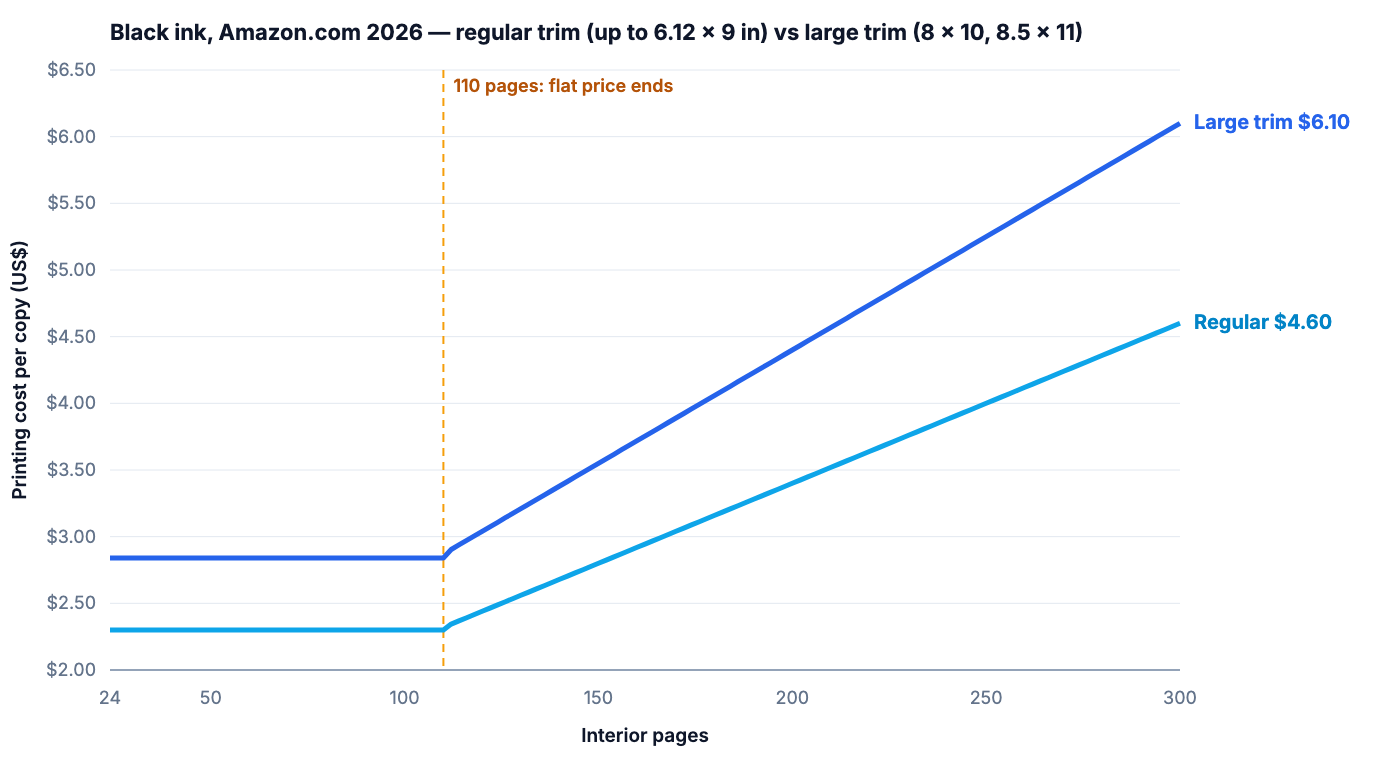
At 100 pages the difference is $0.54 per copy; at 150 pages it is $0.75 and at 200 pages $1.00. Because KDP pays 50% of the list price below $9.99 and 60% from $9.99, a large-trim book often needs the $9.99 price to leave a reasonable royalty — see KDP paperback royalties and the 50% rule, and try your own page count in the royalty calculator.
Note that 8 × 10 in costs the same to print as 8.5 × 11 in. If you are paying for large trim, 8.5 × 11 in gives you the most page for the money unless the smaller format suits your buyers better.
Which trim size suits each type of puzzle book?
| Puzzle book | Common trim | Puzzles per page | Why |
|---|---|---|---|
| Large print word search | 8.5 × 11 in | 1 | 10 × 10 to 12 × 12 grids at 24 pt or more |
| Standard word search | 6 × 9 in | 1 | 15 × 15 grid fits at about 14 pt; cheaper to print |
| Sudoku | 6 × 9 in, or 8.5 × 11 in for large print | 2–6, or 1 | Small grids pack well; large print needs a full page |
| Crossword | 8.5 × 11 in | 1 | The grid and the clue list both need room |
| Cryptogram | 6 × 9 in, or 8.5 × 11 in for large print | 1–2 | Short quotes fit either; large print for older readers |
| Nonogram | 8.5 × 11 in for 20 × 20 and up | 1 | Clue numbers along two edges take space |
| Mazes for kids | 8.5 × 11 in | 1 | Wide paths for crayons |
| Bingo book | 8.5 × 11 in | 1 | One big card per page, easy to read |
| Mandala / coloring | 8.5 × 11 in, single-sided | 1 | Large designs; blank backs stop bleed-through |
| Math workbook | 8.5 × 11 in | 1 | Room to write and easy to photocopy — see how to make a math workbook |
| Handwriting / tracing | 8.5 × 11 in | 1 | Tall writing lines for small hands — see how to make a handwriting practice book |
The guides for each type go into detail: word search, sudoku, mazes, bingo cards and mandala coloring books.
What margins does each trim size need?
The margins depend on page count, not trim size. KDP's inside margin (the gutter, next to the spine) grows as the book gets thicker:
| Page count | Inside margin (gutter) |
|---|---|
| 24–150 | 0.375 in |
| 151–300 | 0.5 in |
| 301–500 | 0.625 in |
| 501–700 | 0.75 in |
| 701–828 | 0.875 in |
Outside, top and bottom margins are at least 0.25 in without bleed. Puzzle interiors almost never need bleed, because nothing is printed to the edge of the page. Many puzzle makers use 0.5 in outside margins anyway, which looks less cramped. The trim size and margin guide gives the exact numbers for any page count.
Once the interior is final, the trim size and page count together set the cover width — use the spine width calculator before you design the cover.
Can you change trim size after publishing?
Not on the same book. On KDP, trim size is locked once a paperback is published; changing it means publishing a new edition. So decide before you build the interior, and print a proof at that size.
A quick way to judge is to print a few pages at home first. Our free printables are all US Letter (8.5 × 11 in), and printing one page scaled to 70% gives a rough idea of how it would look at 6 × 9 in.
Trim size checklist
- Reader chosen first: large print, children, adults, travel
- Grid or design size matched to the trim (measured, not guessed)
- Printing cost checked for your page count and trim class
- Price checked against the $9.99 royalty line
- Gutter set for the final page count
- Proof printed at the final trim size
Frequently asked questions
What trim size is most common for puzzle books on KDP?
8.5 × 11 in for large print, children's activity books and coloring books, and 6 × 9 in for compact adult puzzle books with two or more puzzles per page.
Is 8 × 10 cheaper to print than 8.5 × 11?
No. On Amazon.com both are large trim and cost the same to print per page.
How much more does large trim cost on KDP?
For black ink on Amazon.com, $2.84 instead of $2.30 up to 110 pages — $0.54 more per copy — and the gap grows after that: about $0.75 at 150 pages and $1.00 at 200 pages.
What size is a large print puzzle book?
Usually 8.5 × 11 in with one puzzle per page, so grid letters can be printed at 24 pt or more.
Do puzzle books need bleed?
Usually not. Puzzles are printed inside the margins, so choose "no bleed" for the interior. The cover always needs bleed.
Can I change the trim size of a published KDP paperback?
No. Trim size is fixed once a paperback is published; a different size means publishing a new edition.
KDP Cover Size: How to Work Out a Full-Wrap Paperback Cover
A KDP paperback cover is one image: back, spine and front, plus bleed. Here is the formula, the spine width per page for each paper, worked examples for common trim sizes and the pixel size to export at.
Nov 2, 2026 · 4 min read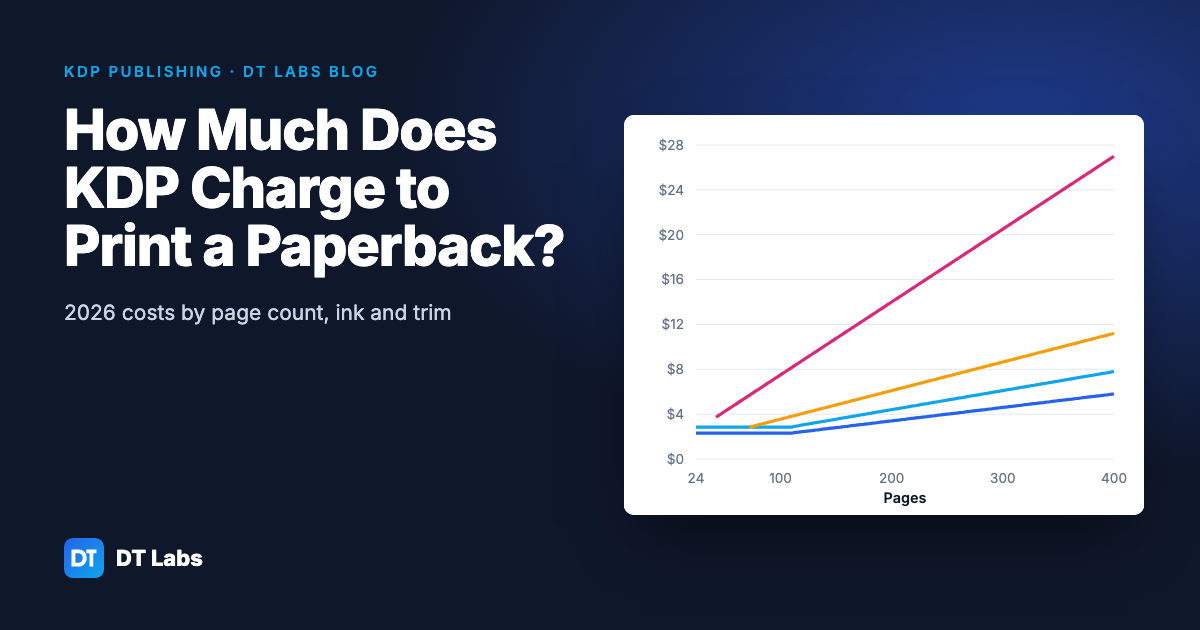
How Much Does KDP Charge to Print a Paperback? (2026 Costs)
KDP's printing cost is a fixed charge plus a charge per page, set by ink and trim size. Here are the 2026 Amazon.com figures, worked examples by page count, and how printing cost sets your lowest list price.
Nov 2, 2026 · 4 min read
ISBN Barcodes for KDP Paperbacks: When You Need Your Own
KDP adds a barcode to your paperback for free. Here is when you still want your own, how to make one from your ISBN, and exactly where it goes on the back cover.
Nov 2, 2026 · 5 min read