
Large Print Word Search for Seniors: Sizes, Fonts and Layout
What makes a word search large print: grid size, letter size, word directions and layout — with measured examples and 30 free printable puzzles.
By Dau Le · · 7 min read
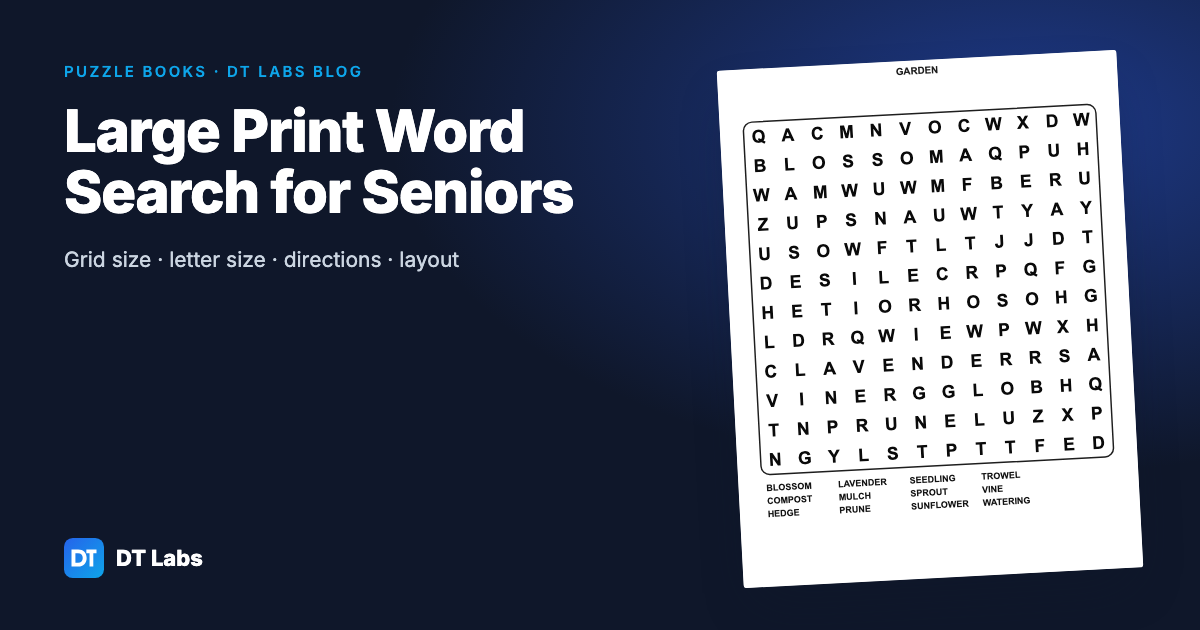
A large print word search is not just a normal puzzle printed bigger. Older readers need fewer, larger letters with space around each one, words that run in easy directions, and a word list they can read without hunting for glasses. This guide gives the measurements — grid size, letter size in points, directions and layout — whether you are printing puzzles for a parent or a care home, or publishing a large print word search book on Amazon KDP.
In short: use one puzzle per US Letter (8.5 × 11 in) page, a 10 × 10 to 12 × 12 grid, bold capital letters of about 27 pt or more, 10–12 words running forwards and down, and a bold word list of at least 14 pt under the grid. Put the answers at the back. You can print 30 free large print word searches made exactly this way.
What makes a word search "large print"?
A word search is large print when the letters in the grid are big enough to read comfortably at arm's length — in practice 24 pt or larger — and the page is not crowded. Three settings decide it: how many squares the grid has, how much of the page the grid fills, and how bold the letters are.
For comparison, many large print books use 16–18 pt for ordinary text. Puzzle grids need to be bigger than that, because the reader scans a block of letters rather than reading words in a line.
| Grid on a US Letter page | Grid letter size | Words per puzzle | Good for |
|---|---|---|---|
| 10 × 10 | about 32 pt | 8–10 | Low vision, young children, a gentler puzzle |
| 12 × 12 | about 27 pt | 10–12 | Most large print readers |
| 15 × 15 | about 22 pt | 14–16 | Readers who want more words and can manage smaller print |
These sizes are measured from pages made with the DT Labs word search maker, where the grid fills the 7.5 in width inside half-inch margins.
Which grid size works for older readers?
12 × 12 is a comfortable default. It leaves room for 10–12 themed words and keeps letters at about 27 pt on a full page. Choose 10 × 10 for readers with low vision or for a gentler puzzle, and 15 × 15 only for readers who find large print slow and want more of a challenge.
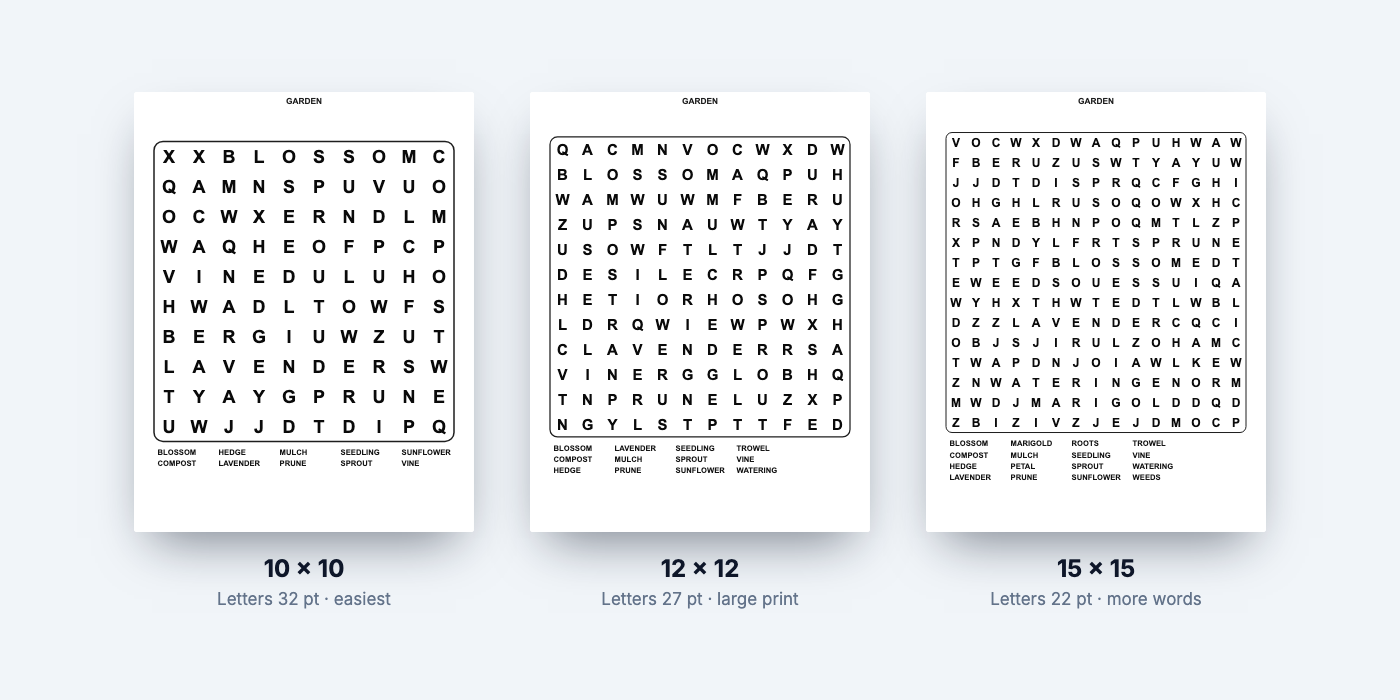
The grid size matters more than the font setting. On a fixed page, a bigger grid always means smaller squares: a 15 × 15 grid squeezes 225 letters into the space a 12 × 12 grid gives 144.
How big should the letters be?
Aim for grid letters of about 24–32 pt in a bold, plain sans-serif typeface, all capitals. In the 12 × 12 puzzles above each letter is 27 pt and sits in a square 0.625 in wide, which leaves clear white space between neighbours.
A few details make as much difference as the point size:
- Capitals only. Lowercase letters such as b, d, p and q are easy to confuse; capitals are not.
- A plain font. Arial-style sans-serif letters read more clearly than decorative or handwritten fonts.
- Black on white. Grey letters, coloured backgrounds and watermarks lower the contrast. Keep decoration off the grid.
- No grid lines between letters. A single border around the whole grid is enough; lines between every square add clutter.
The word list matters too. Print it in bold at about 14 pt or larger, in alphabetical order or in columns, directly under the grid so the reader does not have to turn the page.
Which directions should the words run?
For most older readers, only forwards (left to right) and down. Backwards and diagonal words are what make a word search hard; leaving them out makes the puzzle relaxing without making it trivial.
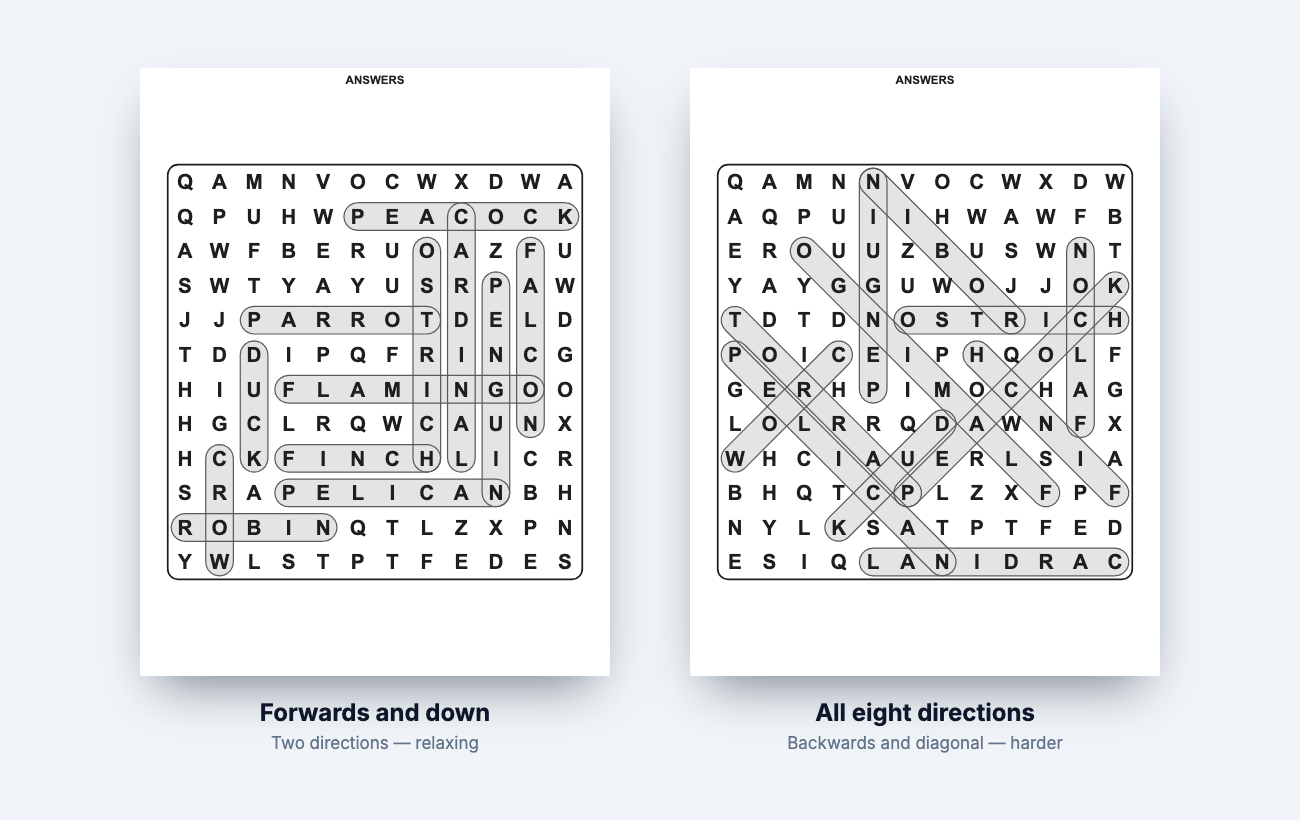
If you are making a book, you can add variety by mixing difficulty: most puzzles forwards and down, a few with diagonals near the end, and say so in the description so buyers know what to expect.
How many words should each puzzle have?
10–12 words suits a 12 × 12 large print grid. That is enough to fill an evening's puzzle without the grid becoming a solid wall of hidden words. Keep words between 3 and 10 letters; very long words do not fit a small grid and very short ones are hard to spot.
Every word should appear exactly once. A word that is hidden twice — or appears inside another word — makes the answer key wrong, and wrong answers are a common complaint in reviews of puzzle books. A generator that verifies the grid saves you from checking each one by hand.
What themes do older readers enjoy?
Familiar, gentle themes work well, with words people know and like saying. Themes that are popular in large print word search books include:
- Home and kitchen: baking, cooking, herbs and spices, tea party, breakfast
- Nature: garden, flowers, birds, trees, weather, the seasons
- Pastimes: music, dance, sewing and knitting, fishing, board and card games, road trips
- Faith and family: books of the Bible, family, around the house, pets
Avoid brand names, film and TV characters and celebrities. Apart from the trademark risk, a puzzle that depends on knowing a show is not fun for someone who has never watched it.
How should a large print word search page be laid out?
Give every puzzle its own page and let the grid use the full width. On US Letter with half-inch margins, the grid can be 7.5 in wide, with the title above and the word list below.
- One puzzle per page. Two puzzles per page halves the letter size.
- A short title at the top, in capitals, so the reader knows the theme.
- The word list under the grid, never on the facing page.
- A page number if the puzzles are in a book, so the answers are easy to find.
- Answers at the back, with every word circled and the same title as its puzzle.
For printing at home, US Letter works on any printer. For a book, 8.5 × 11 in is the usual trim size because it keeps the same page size; see the trim size guide for the margins KDP requires.
How do you print large print word searches at home?
Print at actual size (100%) so the letters stay at their full size. On A4 paper, choose Fit or Shrink to fit; the page scales down by a few percent and stays readable. Black-and-white printing is all you need, and slightly heavier paper (24 lb / 90 gsm) stops a pen showing through.
A clipboard and a thick felt-tip or highlighter make the puzzles easier to hold and mark, especially for people with arthritis or a tremor.
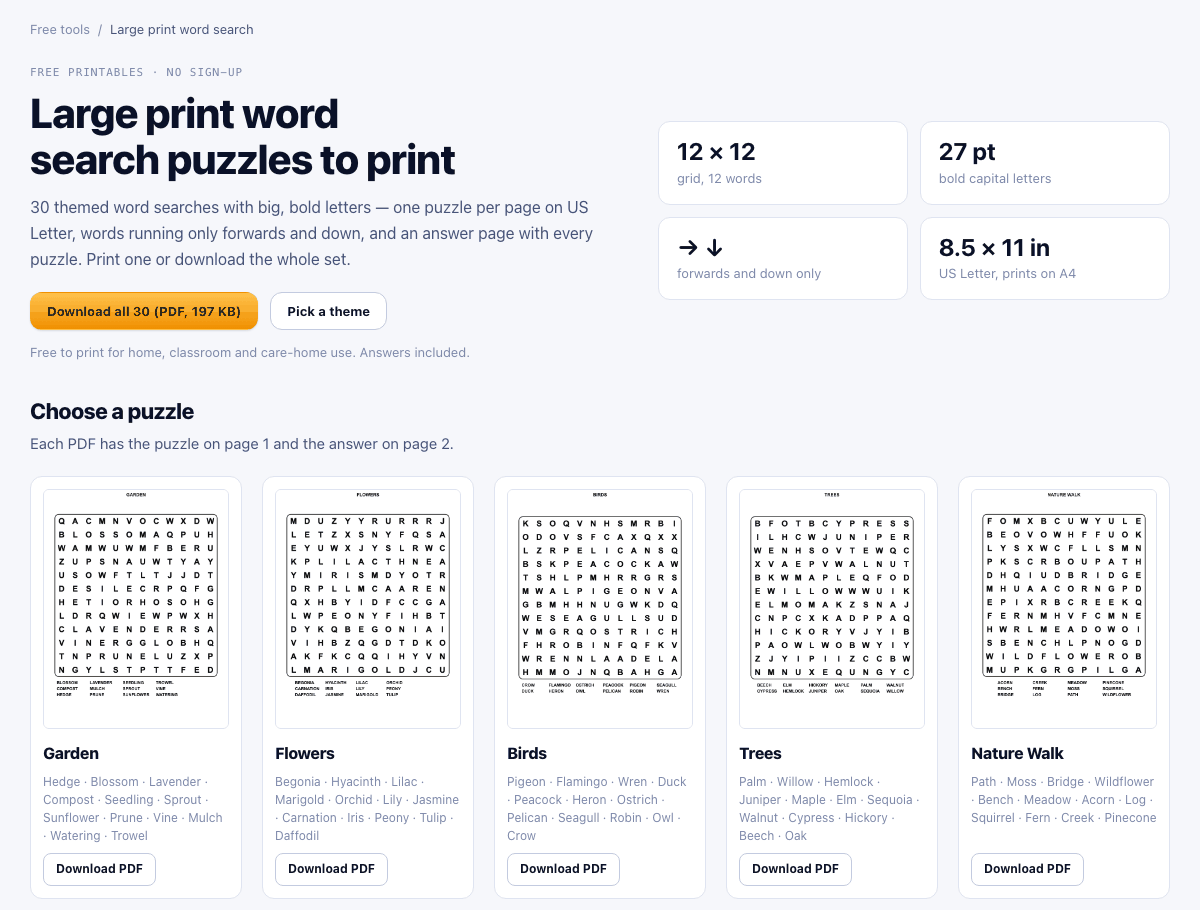
Our free large print word search page has 30 themed puzzles built to the measurements in this guide. Each PDF has the puzzle on page 1 and the answer on page 2, and you can download the whole set in one file. They are free to print for home, classroom and care-home use.
How do you make a large print word search book for KDP?
The same rules apply, with a few publishing details on top:
- Trim size: 8.5 × 11 in, one puzzle per page.
- Grids: mostly 12 × 12 with large print turned on, words forwards and down.
- Page count: 60–90 puzzles with answers four to a page comes to roughly 80–120 pages. More pages cost more to print, so check your royalty with the KDP royalty calculator and read how the 50% rule under $9.99 works.
- Title and cover: put "Large Print" in the title or subtitle and in a bold band on the cover, and show a real puzzle so shoppers can judge the letter size from the thumbnail.
- Large print setting: KDP's paperback setup has a large print option. Check KDP's current help page for its font size requirement before you tick it.
- Proof copy: order a printed proof and read a puzzle without glasses at arm's length. If it is hard to read, it is not large print yet.
The full step-by-step process — theme research, answer keys, cover and upload — is in how to make a word search book for Amazon KDP. The word search maker has a large print setting that scales the grid, word list and page titles together, and exports a KDP-ready PDF with answer keys and a commercial licence.
Large print checklist
- One puzzle per US Letter or 8.5 × 11 in page
- 10 × 10 or 12 × 12 grid filling the page width
- Bold capital letters of about 24 pt or more
- 10–12 words, forwards and down only
- Bold word list of 14 pt or more under the grid
- Black on white, no grey text or background images
- Every word appears exactly once; answers at the back
- Printed proof read at arm's length
Frequently asked questions
What size font is large print for a word search?
Grid letters of about 24–32 pt in bold capitals, with a word list of 14 pt or more. A 12 × 12 grid filling a US Letter page gives letters of about 27 pt.
Which grid size is right for seniors?
A 12 × 12 grid suits most large print readers. Use 10 × 10 for low vision or a gentler puzzle, and 15 × 15 only for readers who want more words and can manage smaller letters.
Should large print word searches have diagonal words?
Usually not. Words that run only forwards and down keep the puzzle relaxing; backwards and diagonal words make it noticeably harder.
How many words should a large print word search have?
Around 10–12 words for a 12 × 12 grid, between 3 and 10 letters long.
Where can I print free large print word searches?
DT Labs has 30 free large print word searches at dtlabs.app/large-print-word-search, each with an answer page, free to print for home, classroom and care-home use.
Can I sell large print word search books I make myself?
Yes, if the tool you use gives you a commercial licence for its output. Puzzles made with the DT Labs word search maker can be sold on Amazon KDP and Etsy.
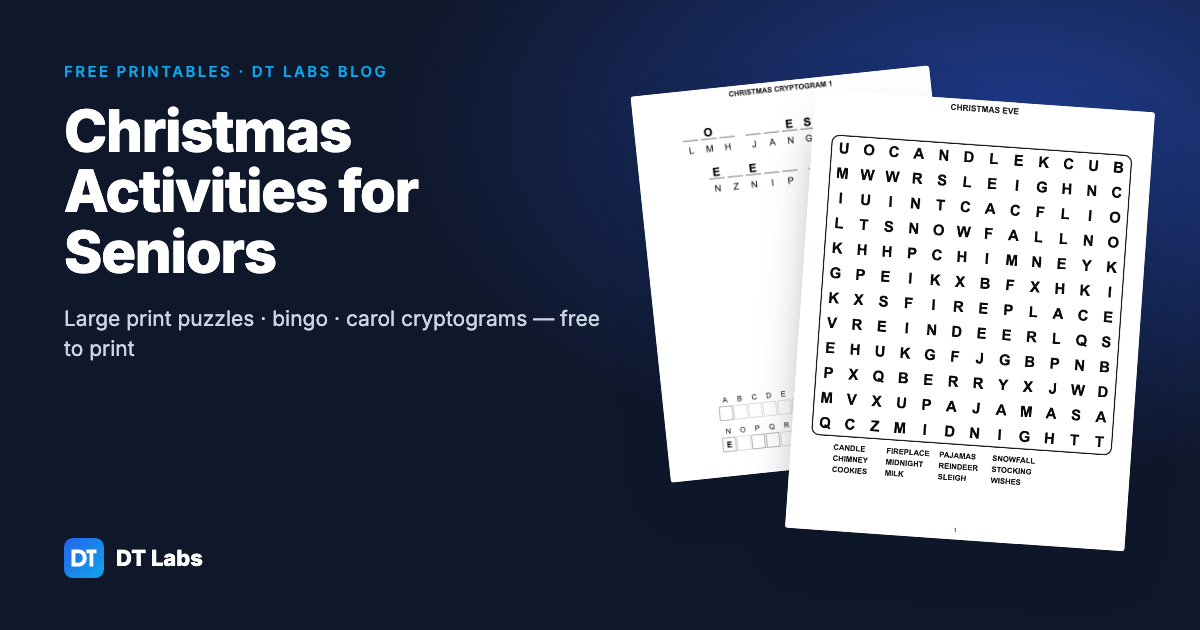
Christmas Activities for Seniors: Large Print Puzzles, Bingo and Carols
Christmas activities for seniors at home, in care homes and in church groups — large print Christmas word searches, bingo, carol cryptograms, crosswords and ornament coloring pages, with free printables and answers.
Nov 2, 2026 · 4 min read
Christmas Activities for Kids: 12 Printable Games and Puzzles
Twelve Christmas activities for kids at home and in the classroom — word searches, bingo, tree and snowman mazes, dot-to-dots, crosswords and an advent puzzle calendar — with free printables and answers.
Nov 2, 2026 · 4 min read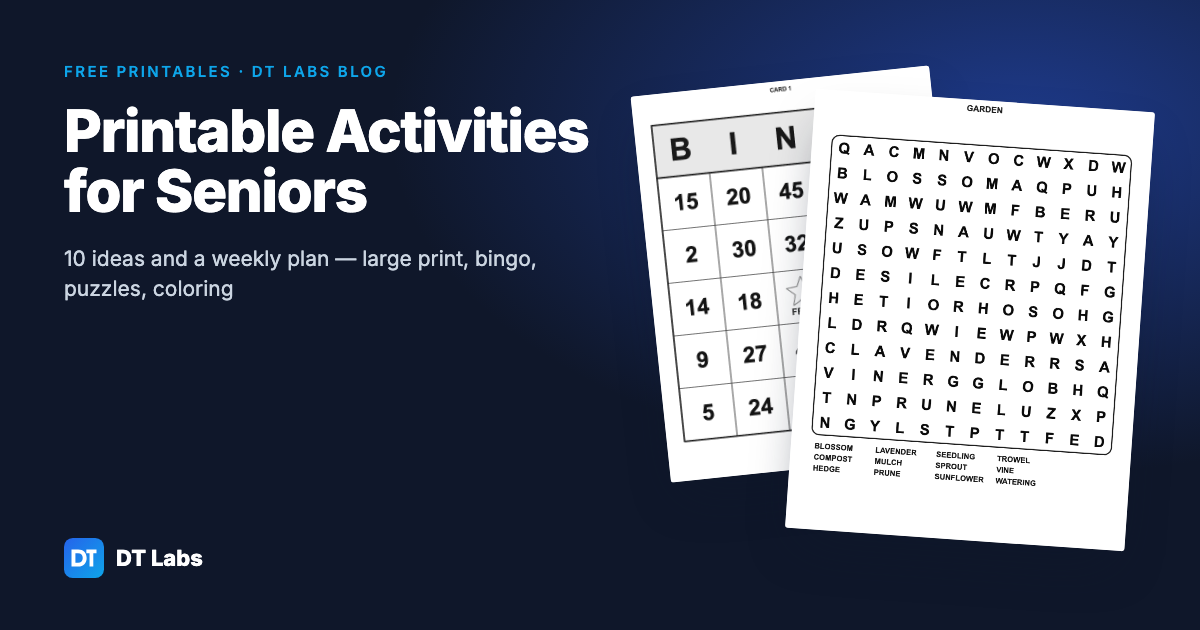
Printable Activities for Seniors: 10 Ideas and a Weekly Plan
Ten printable activities for seniors at home, in care homes and in community groups — large print word searches, bingo, easy sudoku, proverb cryptograms, crosswords and coloring — plus a simple weekly plan, all free to print.
Nov 2, 2026 · 4 min read