
KDP Paperback Royalties 2026: The 50% Rule Under $9.99
On Amazon.com, KDP pays 60% of a paperback's price from $9.99 and 50% below it, minus printing. See what that does to your royalty, with worked examples.
By Dau Le · · 6 min read
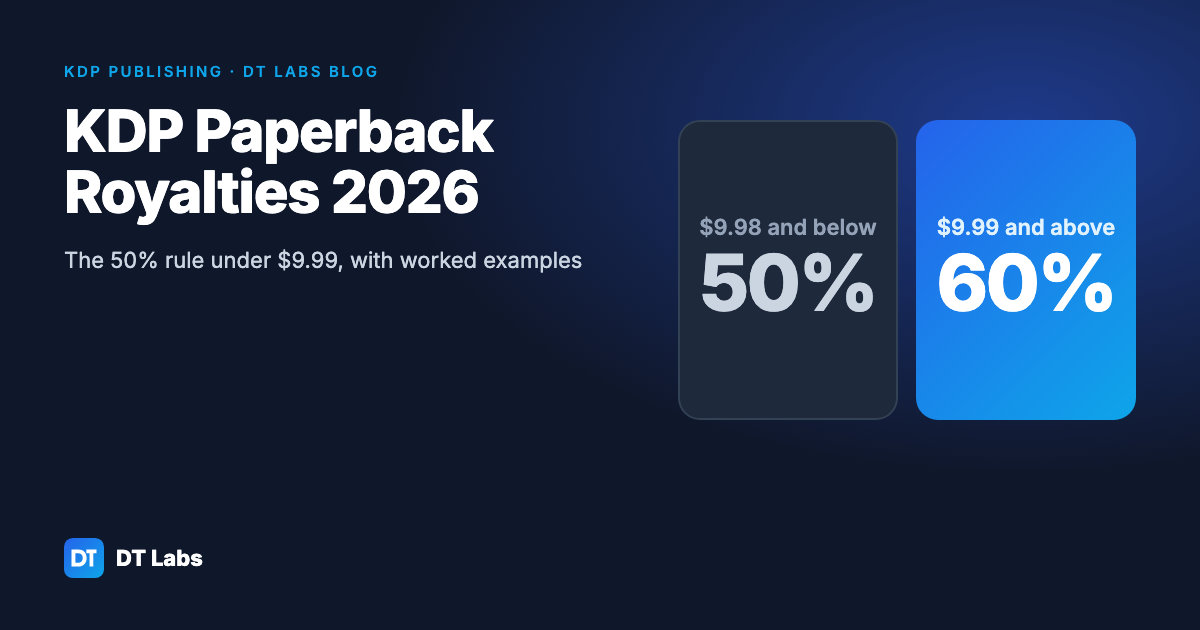
On Amazon.com, KDP pays 60% of a paperback's list price when it is $9.99 or more, and 50% when it is $9.98 or less — then subtracts the printing cost. That one-cent line changes how paperbacks should be priced, especially puzzle books, journals and other low-content books that often sell for under $10.
In short: royalty = rate × list price − printing cost. The rate is 50% up to $9.98 and 60% from $9.99 on Amazon.com, so the step from $9.98 to $9.99 is worth about $1.00 per copy whatever your book costs to print. Printing depends only on page count, ink and trim size, and it also sets the lowest price KDP will accept.
How are KDP paperback royalties calculated?
Royalty per copy = royalty rate × list price − printing cost. On Amazon.com the rate is 60% for list prices of $9.99 and above and 50% for $9.98 and below. Books sold through Expanded Distribution — bookshops, libraries and other retailers — earn a flat 40%, minus printing.

Two things follow from the formula:
- Printing is subtracted in full whatever price you choose. A lower price takes a smaller share of a fixed cost.
- The rate applies to the whole price, not just the part above $9.99. Crossing the line lifts the rate on every cent.
What changed in 2025?
Paperbacks on Amazon.com used to earn 60% at any list price. In 2025 KDP introduced the lower 50% rate for paperbacks priced below $9.99. Books priced at $9.99 or more were not affected, which is why so many paperbacks now sit at exactly $9.99. If you published before the change and priced under $9.99, your per-copy royalty dropped even though nothing in your book changed.
How much does KDP charge to print a paperback?
For black ink on white or cream paper, Amazon.com printing in 2026 works like this:
| Trim size | Pages | Printing cost |
|---|---|---|
| Regular (up to 6.12 × 9 in) | 24–110 | $2.30 flat |
| Regular (up to 6.12 × 9 in) | 111–828 | $1.00 + $0.012 per page |
| Large (wider or taller than 6.12 × 9 in) | 24–110 | $2.84 flat |
| Large (wider or taller than 6.12 × 9 in) | 111–828 | $1.00 + $0.017 per page |
Colour costs more per page:
| Ink | Regular trim | Large trim |
|---|---|---|
| Standard colour | $1.00 + $0.0255 per page | $1.00 + $0.0402 per page |
| Premium colour (over 40 pages) | $1.00 + $0.065 per page | $1.00 + $0.08 per page |
The flat band matters: a black-ink book of 24 pages and one of 110 pages cost the same to print. Above 110 pages every extra page adds a little, so trimming blank or filler pages lowers the cost. The KDP royalty calculator works all of this out for any page count.
What does the 50% rule do to a typical book?
It makes the last cent before $9.99 expensive. These examples use the Amazon.com rates above, rounded to the cent:
| List price | 6 × 9 in, 120 pages (printing $2.44) | 8.5 × 11 in, 104 pages (printing $2.84) |
|---|---|---|
| $7.99 (50%) | $1.56 | $1.16 |
| $8.99 (50%) | $2.06 | $1.66 |
| $9.98 (50%) | $2.55 | $2.15 |
| $9.99 (60%) | $3.55 | $3.15 |
| $11.99 (60%) | $4.75 | $4.35 |
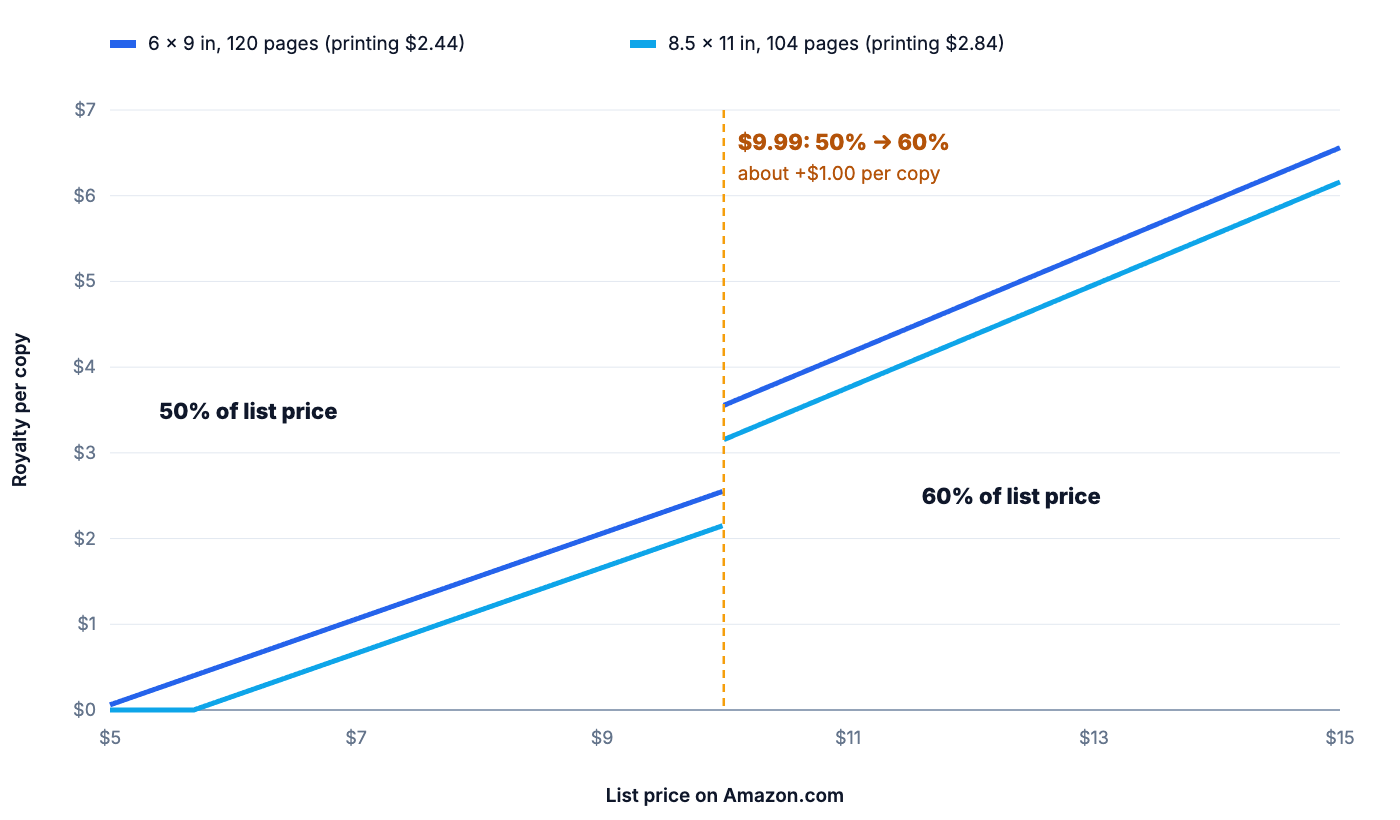
Moving from $9.98 to $9.99 adds one cent for the buyer and about $1.00 per copy for you — 60% × $9.99 − 50% × $9.98 = $1.00. Because the printing cost is the same on both sides, the jump is the same for every black-and-white book. Moving from $8.99 to $9.99 adds about $1.50 per copy.
These are per-copy royalties, not a forecast of sales. Whether a higher price sells is up to your market — check what similar books in your niche cost before you decide.
Is there a minimum list price on KDP?
Yes. KDP will not let you set a price where the royalty would be below zero, so the minimum is the printing cost divided by the royalty rate. A 6 × 9 in, 120-page book costs $2.44 to print, so its minimum at 50% is $4.88.
Thicker and larger books hit the line sooner:
| Pages | 6 × 9 in: printing / lowest price | 8.5 × 11 in: printing / lowest price |
|---|---|---|
| 24–110 | $2.30 / $4.60 | $2.84 / $5.68 |
| 150 | $2.80 / $5.60 | $3.55 / $7.10 |
| 200 | $3.40 / $6.80 | $4.40 / $8.81 |
| 250 | $4.00 / $8.00 | $5.25 / $9.99 |
| 300 | $4.60 / $9.20 | $6.10 / $10.17 |

At 300 pages a 6 × 9 in book cannot be sold at $7.99 or $8.99 at all, and an 8.5 × 11 in book needs to be at least $10.17. Once the 50% minimum would pass $9.99, the 60% rate sets the minimum instead — that is why a 250-page, 8.5 × 11 in book can still be priced at exactly $9.99.
Should puzzle and low-content books be priced at $9.99?
Not automatically, but run the numbers before you choose $7.99 or $8.99. Puzzle books are often priced under $10, and under the 50% rule the lower prices leave noticeably less per copy.
Three ways sellers handle it:
- Price at $9.99 and make the book visibly worth it: more puzzles, large print, a theme buyers care about, a clean cover. The extra dollar per copy pays for a better book.
- Lower the printing cost: answers four or six to a page instead of one, no blank backs unless the format needs them, and a regular trim size instead of a large one where the format allows. Twenty fewer pages saves $0.24 at regular trim or $0.34 at large trim once you are above 110 pages.
- Keep a lower price on purpose: for a first book, a series starter or a seasonal gift where price matters most, knowing the per-copy royalty is smaller.
The trim size guide shows margins for each size if you are deciding between 6 × 9 in and 8.5 × 11 in, and how to make a word search book for KDP covers page counts for puzzle books.
How does Expanded Distribution change the numbers?
Expanded Distribution sends your paperback to bookshops, libraries and other retailers. It pays a flat 40% of the list price, minus the same printing cost — there is no $9.99 threshold.
For the 6 × 9 in, 120-page example at $9.99, an Expanded Distribution sale earns 40% × $9.99 − $2.44 ≈ $1.56, compared with $3.55 on Amazon.com. The lowest price for Expanded Distribution is also higher: $2.44 ÷ 40% = $6.10. Low-content books published without an ISBN cannot use Expanded Distribution at all.
Does the 50% rule apply on other Amazon marketplaces?
The thresholds in this guide are for Amazon.com in US dollars. Other marketplaces have their own price thresholds and printing costs in their own currencies, so check each one in KDP's pricing screen before you publish. Kindle eBooks follow a different system (35% or 70%) and are not covered here.
How do you check your own royalty?
- Export your interior and note the exact page count.
- Enter list price, page count, ink and trim size in the KDP royalty calculator. It shows the printing cost, which rate applies, the royalty per copy and the lowest price KDP will accept.
- Try your price at $9.98 and $9.99 to see the difference for your book.
- Confirm in KDP's own printing cost and royalty calculator and in the pricing screen, which always has the final say.
Checklist before you set a price
- Final page count, after the last interior change
- Printing cost for your trim, ink and page count
- Royalty at your chosen price, and at $9.99 for comparison
- Prices of the top books in your niche
- Whether you want Expanded Distribution (it needs an ISBN)
If you are building a puzzle book, the DT Labs word search maker shows the page count of the whole book as you change grids and answers per page, so you can see the printing cost before you export.
Frequently asked questions
What royalty does KDP pay on paperbacks?
On Amazon.com, 60% of the list price for paperbacks priced at $9.99 or more and 50% for $9.98 or less, minus the printing cost. Expanded Distribution pays 40% minus printing.
Why does $9.99 earn so much more than $9.98?
Because the rate jumps from 50% to 60% at $9.99 and applies to the whole price. The difference is about $1.00 per copy for one extra cent, whatever the book costs to print.
Does the printing cost change with the list price?
No. Printing depends only on page count, ink and trim size, so it is subtracted in full whatever price you choose.
How do I find the lowest price KDP allows?
Divide the printing cost by the royalty rate. A book that costs $2.44 to print has a minimum of $4.88 at the 50% rate.
When did KDP introduce the 50% paperback rate?
In 2025, for paperbacks priced below $9.99 on Amazon.com. Before that, paperbacks earned 60% at any list price.
Is a 110-page book cheaper to print than a 120-page one?
Yes, slightly. Black-ink paperbacks cost a flat amount up to 110 pages, then a per-page charge applies: a regular-trim book of 120 pages costs $2.44 to print against $2.30 at 110 pages.
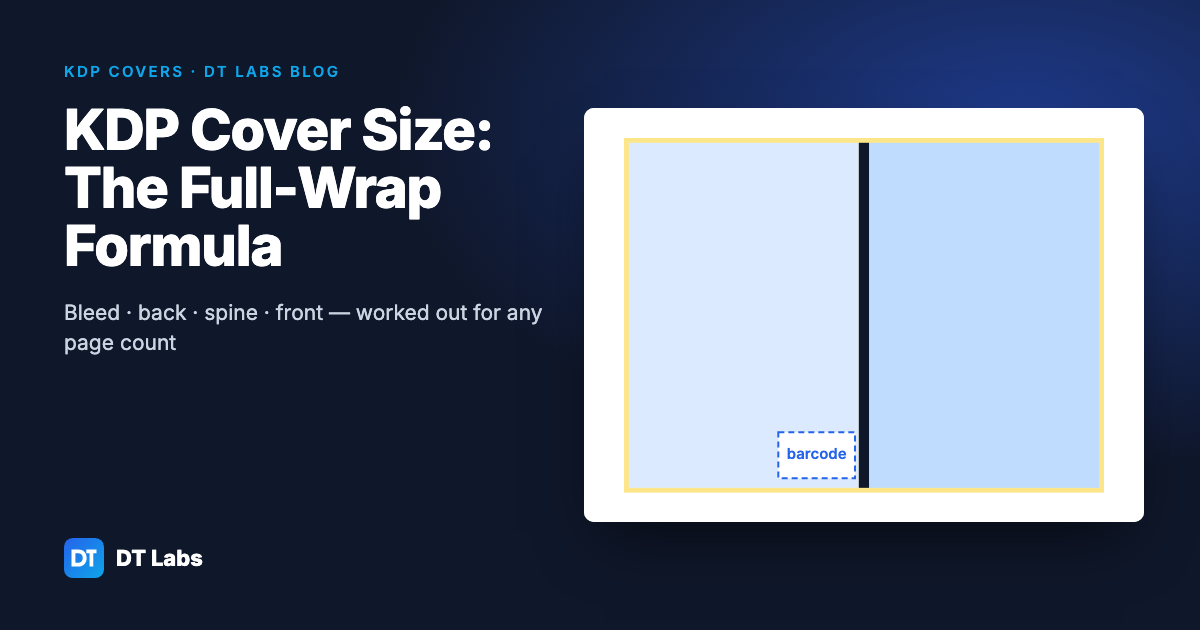
KDP Cover Size: How to Work Out a Full-Wrap Paperback Cover
A KDP paperback cover is one image: back, spine and front, plus bleed. Here is the formula, the spine width per page for each paper, worked examples for common trim sizes and the pixel size to export at.
Nov 2, 2026 · 4 min read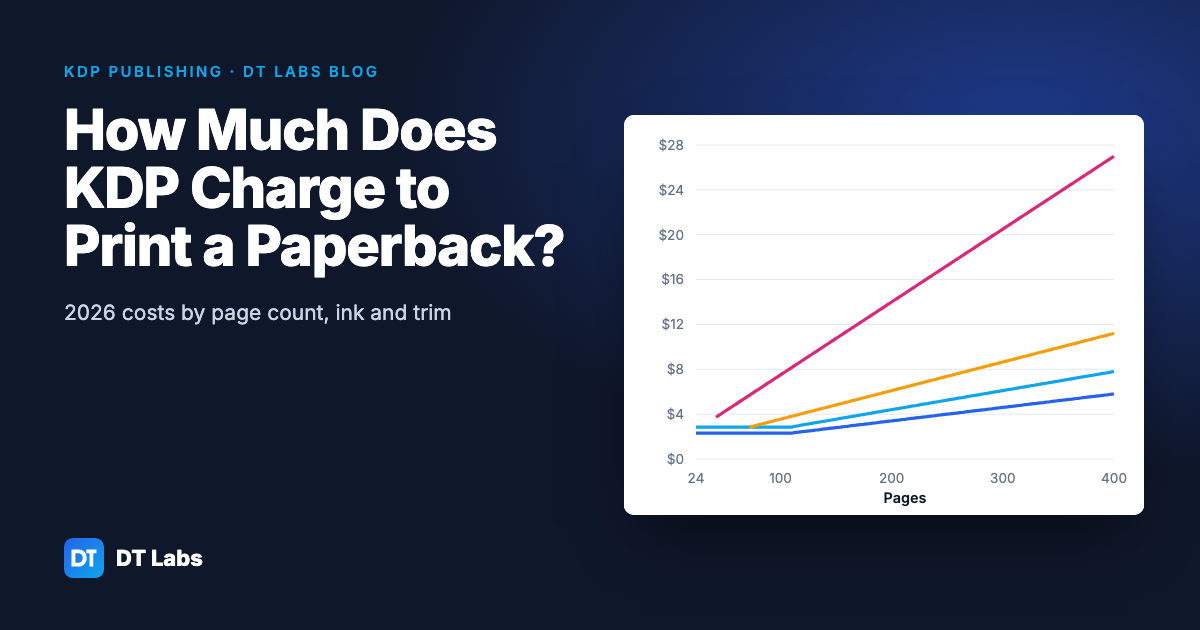
How Much Does KDP Charge to Print a Paperback? (2026 Costs)
KDP's printing cost is a fixed charge plus a charge per page, set by ink and trim size. Here are the 2026 Amazon.com figures, worked examples by page count, and how printing cost sets your lowest list price.
Nov 2, 2026 · 4 min read
ISBN Barcodes for KDP Paperbacks: When You Need Your Own
KDP adds a barcode to your paperback for free. Here is when you still want your own, how to make one from your ISBN, and exactly where it goes on the back cover.
Nov 2, 2026 · 5 min read