
How to Make a Handwriting Practice Book for KDP (Ages 3–7)
Make a handwriting practice book for Amazon KDP: the order to teach in, line sizes by age, stroke order, sight words, trim size, page count and price.
By Dau Le · · 6 min read
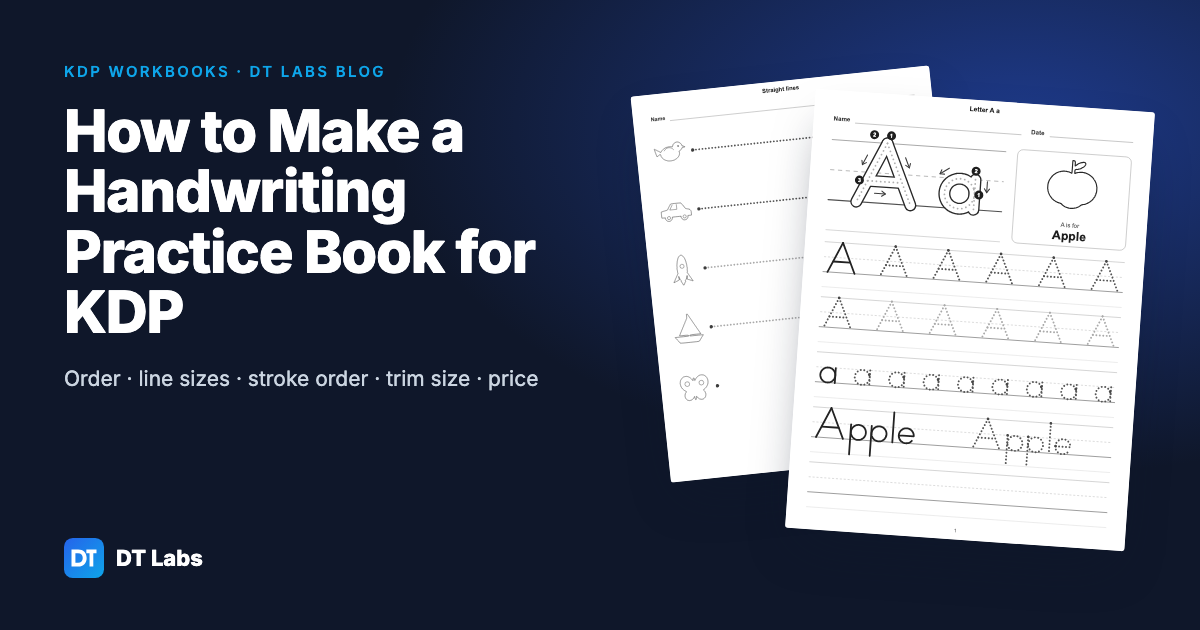
Handwriting practice books are among the most searched activity books for young children — and the pages look easy to make. The difference between a book parents keep buying and one they return is in the details: lines that are too small for a four-year-old, letters with no stroke order, or a book that starts with sentences before a child can hold a pencil. This guide covers how to make a handwriting practice book for Amazon KDP: the order to teach in, line sizes by age, stroke order, sight words, trim size, page count and price.
In short: pick one age and one stage — pre-writing, letters, numbers or words — use lines sized for that age, show numbered stroke order on every model letter, fade the tracing from dark dots to a blank row, and check the page count against the printing cost before you set a price. You can see every stage on paper with our free printable tracing worksheets.
What do you need to make a handwriting practice book?
A tracing worksheet generator with proper handwriting lines (a top line, a dashed middle line and a baseline), letters drawn with stroke order, and export at KDP trim sizes; a cover sized to your page count; and a free KDP account. The DT Labs tracing worksheet generator draws its own single-stroke print letters, so the dotted letters are traced in the same strokes a child is taught to write — no installed font needed.
In what order should a handwriting book teach?
Children learn to control a pencil before they learn letters, so a book that follows the same order feels right to parents and teachers.
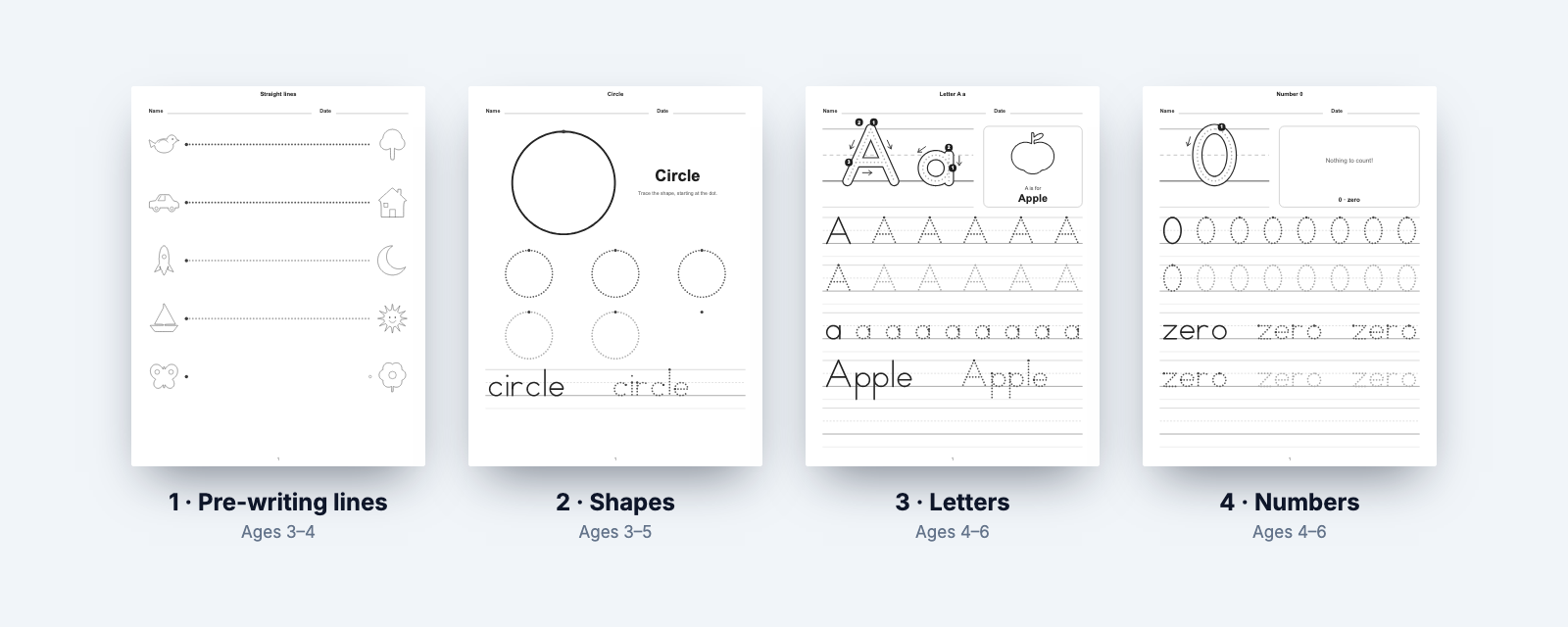
- Pre-writing lines (ages 3–4): straight, slanted, zigzag, wavy and looping lines, each from a picture to a picture. These build the strokes letters are made of.
- Shapes (ages 3–5): circles, squares, triangles and stars — the circle is the start of a, c, d, g, o and q.
- Letters (ages 4–6): capitals and lowercase, one letter per page, with a picture word.
- Numbers (ages 4–6): 0 to 10 or 0 to 20, with things to count and the number word.
- Sight words and sentences (ages 5–7): common words traced, then copied, then short sentences.
A book can cover one stage in depth ("Pre-Writing Practice for Toddlers") or several in order ("Preschool Tracing Book: Lines, Shapes, Letters and Numbers"). Say which in the subtitle.
What line size suits each age?
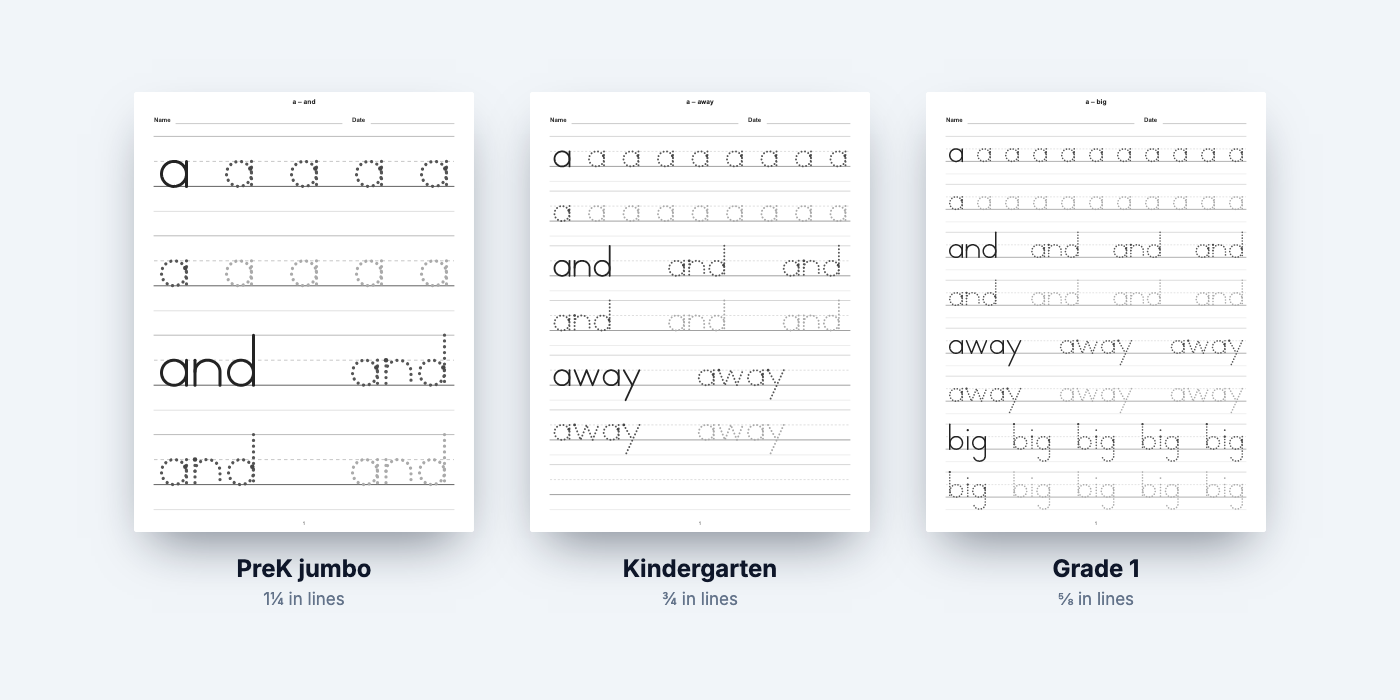
Line height is the distance from the top line to the baseline. Younger children need taller lines; too small is the most common complaint about tracing books.
| Age | Line height | Fits on a US Letter page |
|---|---|---|
| PreK (3–4) | 1¼ in "jumbo" | a few big letters per row |
| PreK–K (4–5) | 1 in | short words |
| Kindergarten (5–6) | ¾ in | words and short phrases |
| Grade 1 (6–7) | ⅝ in | sentences |
| Grades 2–3 | ½ in | copywork |
These are common sizes on school handwriting paper. Keep one size through a section; a sudden jump to smaller lines halfway through the book is easy to notice.
How should the tracing be laid out on each page?
A good letter page moves the child from following to writing on their own:
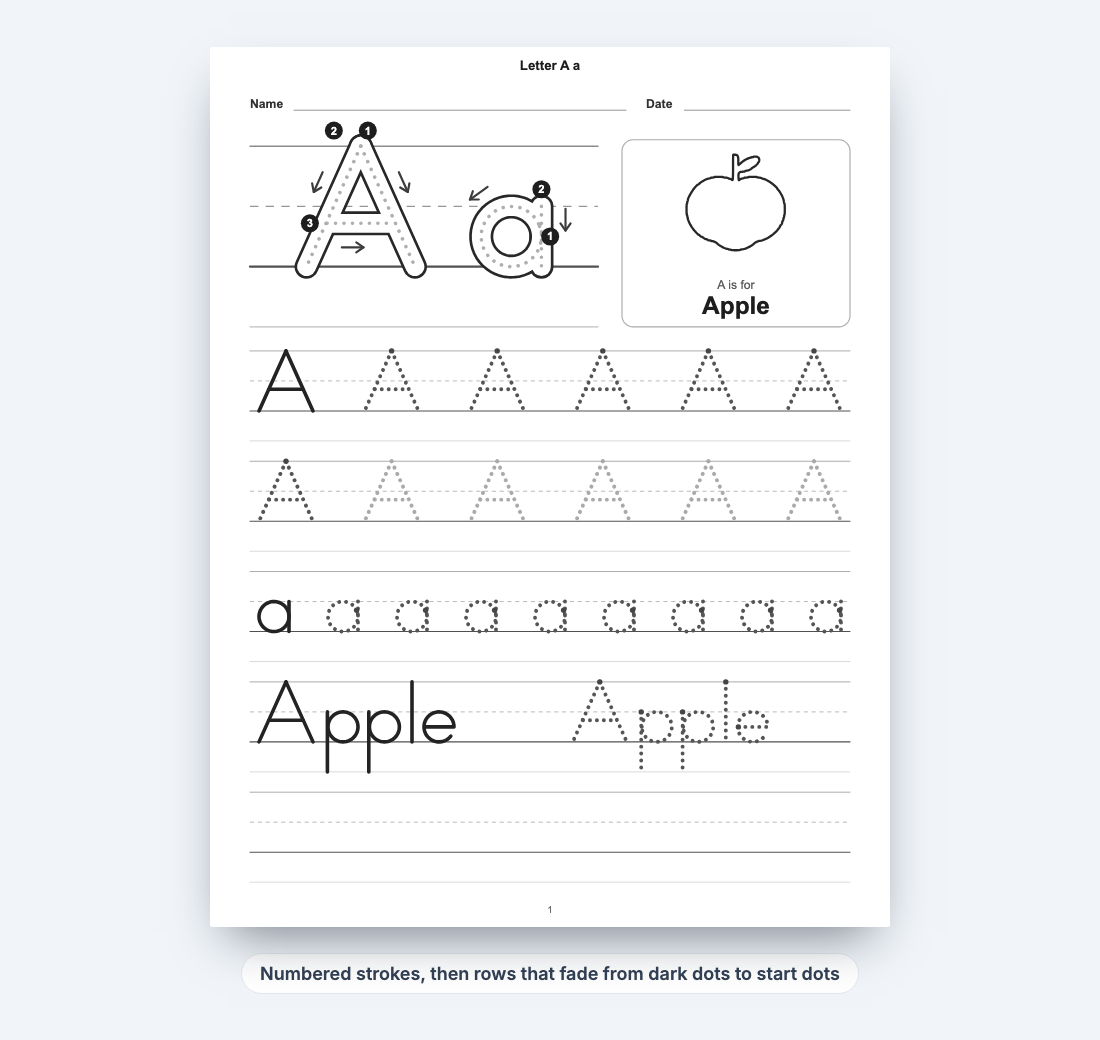
- A big model letter with numbered strokes and arrows, so the child knows where to start and which way to go.
- Rows that fade: dark dots, then light dots, then only a starting dot, then an empty row to write alone.
- A picture word ("A is for Apple") to connect the letter to its sound.
- Name and date lines at the top — teachers use them, and parents like to see progress.
Print or slanted letters?
Most US preschools teach vertical print letters first. Some programmes use a slanted print that leads into joined writing later. Pick one style for a whole book and say which in the description, since parents often match the style their school uses.
What about sight words and name tracing?
Sight-word books are a natural next step: the Dolch pre-primer list has 40 words and the primer list 52. Two rows per word — one to trace, one to trace on light dots — keeps a list of 40 words to about 20 pages.
Name tracing is a popular personalised printable on Etsy: one page per child's name, traced and then copied. It works better as a digital download than a paperback, because each copy is for one child.
What trim size, page count and price work for a handwriting book?
Use 8.5 × 11 in: children need the room, and the line sizes above assume a full page. Two example formats, priced with Amazon.com's 2026 printing costs (black ink):
| Book | Pages | Printing | Royalty at lower price | Royalty at $9.99 |
|---|---|---|---|---|
| Preschool: lines, shapes, A–Z, 0–20 | about 68 | $2.84 | about $1.16 at $7.99 | about $3.15 |
| Sight words and sentences, ages 5–7 | about 120 | about $3.04 | about $1.46 at $8.99 | about $2.95 |
Below $9.99, KDP pays 50% of the list price instead of 60% — see KDP paperback royalties and the 50% rule. These are per-copy royalties, not a sales forecast; check your own numbers in the royalty calculator.
Check margins in the trim size guide — handwriting lines should stay well inside the margin, because the binding side curves away from the pencil — and size the cover with the spine width calculator once the page count is final.
How do you publish the handwriting book on KDP?
- Title and subtitle: say the age, the stage and what is inside — for example "Letter Tracing Book for Preschoolers Ages 3–5: Lines, Shapes, Letters and Numbers".
- ISBN: use KDP's free ISBN; a workbook with instructional pages is usually not published as low-content.
- Reading age: set it in the KDP details so the book is shown to the right buyers.
- Upload the interior and cover PDFs and fix anything the previewer flags.
- Order a proof and trace a page with a thick pencil or crayon: are the dots easy to follow, and is there room for a small hand?
- Description: list the stages in order, the line size, the number of pages and that letters show stroke order.
Try the pages on paper first
Our free printable tracing worksheets page has 92 pages in six sets — the alphabet with stroke order, numbers 0–20, pre-writing lines, shapes and two Dolch sight-word lists. Printing one set is the quickest way to judge which line size fits the age you have in mind.
When you are ready, the tracing worksheet generator makes alphabet, number, sight-word, name, sentence, pre-writing and shape pages in six line sizes from PreK jumbo to adult, in vertical or slanted print, and exports a KDP-ready PDF. It is free, and exports carry a commercial licence. For the next stage up, see how to make a math workbook for KDP.
Handwriting book checklist
- One age and one stage (or stages in teaching order), named on the cover
- Line size matched to that age, the same through each section
- Numbered stroke order on every model letter and number
- Rows that fade from dark dots to an empty row
- One letter style (vertical or slanted) through the book
- Page count and printing cost checked against the price
- Proof copy traced with a crayon or thick pencil
Frequently asked questions
What line size is best for preschool handwriting?
Tall lines — about 1 to 1¼ in from the top line to the baseline — for ages 3 to 5. Kindergarten usually uses ¾ in lines and grade 1 about ⅝ in.
What order should children learn handwriting in?
Pre-writing lines first, then shapes, then capital and lowercase letters and numbers, and finally sight words and short sentences.
How many pages should a tracing book have?
Many preschool tracing books have 60 to 120 pages: one page per letter and number, plus pre-writing and shape pages or word practice.
Should a tracing book show stroke order?
Yes. Numbered strokes with arrows show where each line starts and which way it goes, which is what parents and teachers look for.
What trim size is good for a handwriting practice book?
8.5 × 11 in. It gives young children room to write on tall lines.
Where can I get free printable tracing worksheets?
DT Labs has 92 free printable tracing worksheets at dtlabs.app/printable-tracing-worksheets: the alphabet with stroke order, numbers 0–20, pre-writing lines, shapes and Dolch sight words.
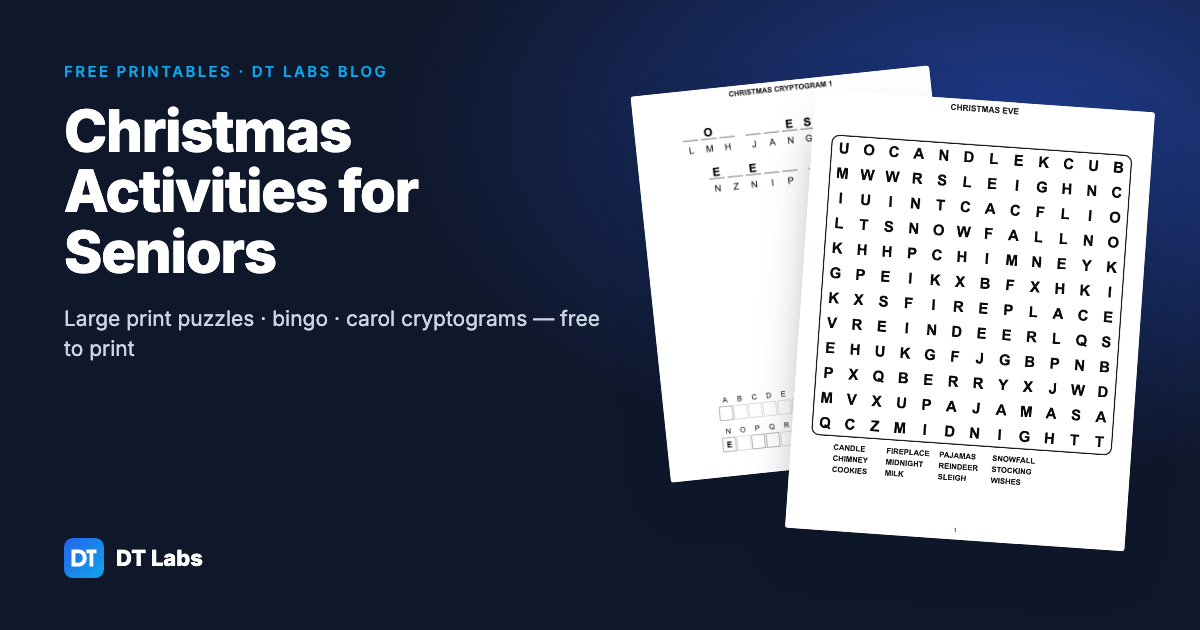
Christmas Activities for Seniors: Large Print Puzzles, Bingo and Carols
Christmas activities for seniors at home, in care homes and in church groups — large print Christmas word searches, bingo, carol cryptograms, crosswords and ornament coloring pages, with free printables and answers.
Nov 2, 2026 · 4 min read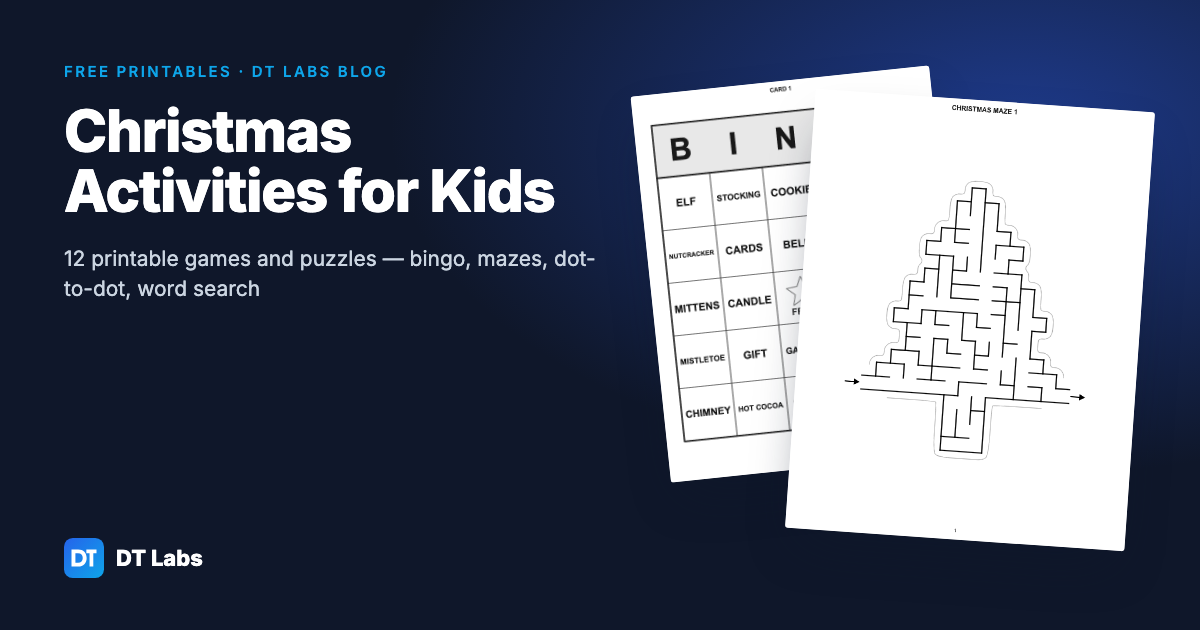
Christmas Activities for Kids: 12 Printable Games and Puzzles
Twelve Christmas activities for kids at home and in the classroom — word searches, bingo, tree and snowman mazes, dot-to-dots, crosswords and an advent puzzle calendar — with free printables and answers.
Nov 2, 2026 · 4 min read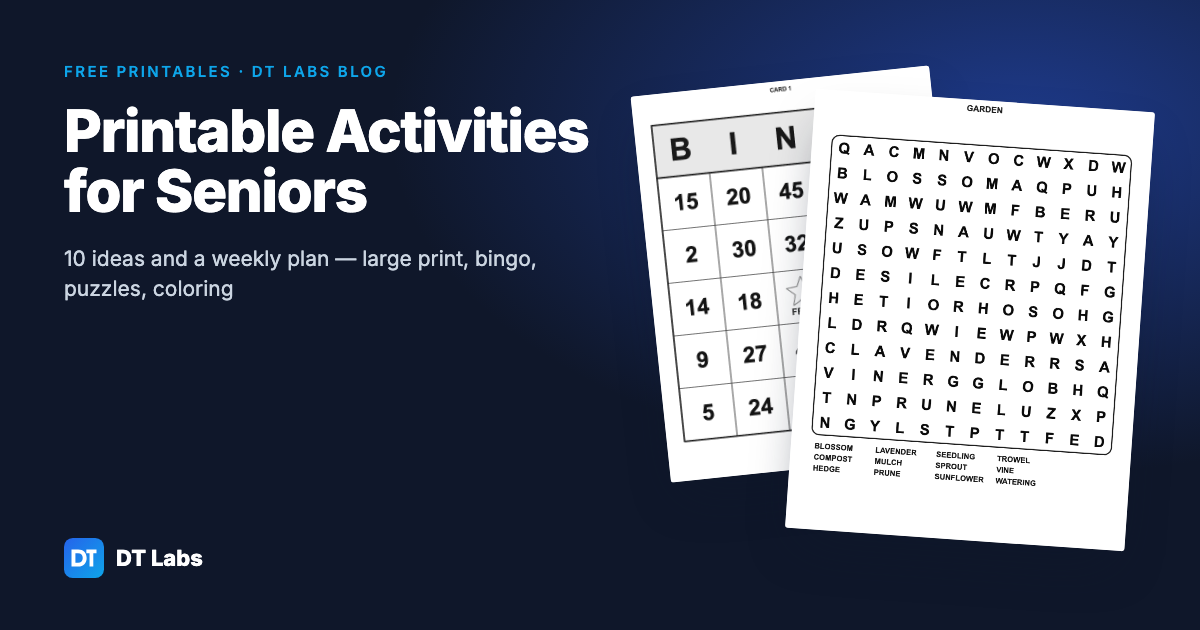
Printable Activities for Seniors: 10 Ideas and a Weekly Plan
Ten printable activities for seniors at home, in care homes and in community groups — large print word searches, bingo, easy sudoku, proverb cryptograms, crosswords and coloring — plus a simple weekly plan, all free to print.
Nov 2, 2026 · 4 min read