
How to Make a Maze Book for KDP: Kids to Adults
Make a maze book for Amazon KDP: maze size and difficulty by age, shapes and circular mazes, solution pages, trim size, page count and price.
By Dau Le · · 6 min read

A maze book is one of the easiest activity books to understand — and one of the easiest to get wrong. Mazes that are too hard for the age on the cover, paths too thin to draw in, or a solution page that does not match are the complaints that show up in reviews. This guide covers how to make a maze book for Amazon KDP that suits its reader: size and difficulty by age, shapes, solutions, trim size, page count and price.
In short: pick one age group, match the maze size and difficulty to it, use one maze per page for children, add solutions at the back, and check the page count against the printing cost before you set a price. You can see the levels on paper with our free printable mazes.
What do you need to make a maze book?
A maze generator that makes "perfect" mazes — exactly one path from start to finish — and exports print-ready pages with solutions, a cover sized to your page count, and a free KDP account. The DT Labs maze generator builds the whole interior in your browser: title page, instructions, mazes and solution pages, at KDP trim sizes.
What maze size and difficulty suit each age?
Match two things to the reader: how many cells the maze has, which sets how small the paths are, and how winding the solution is.
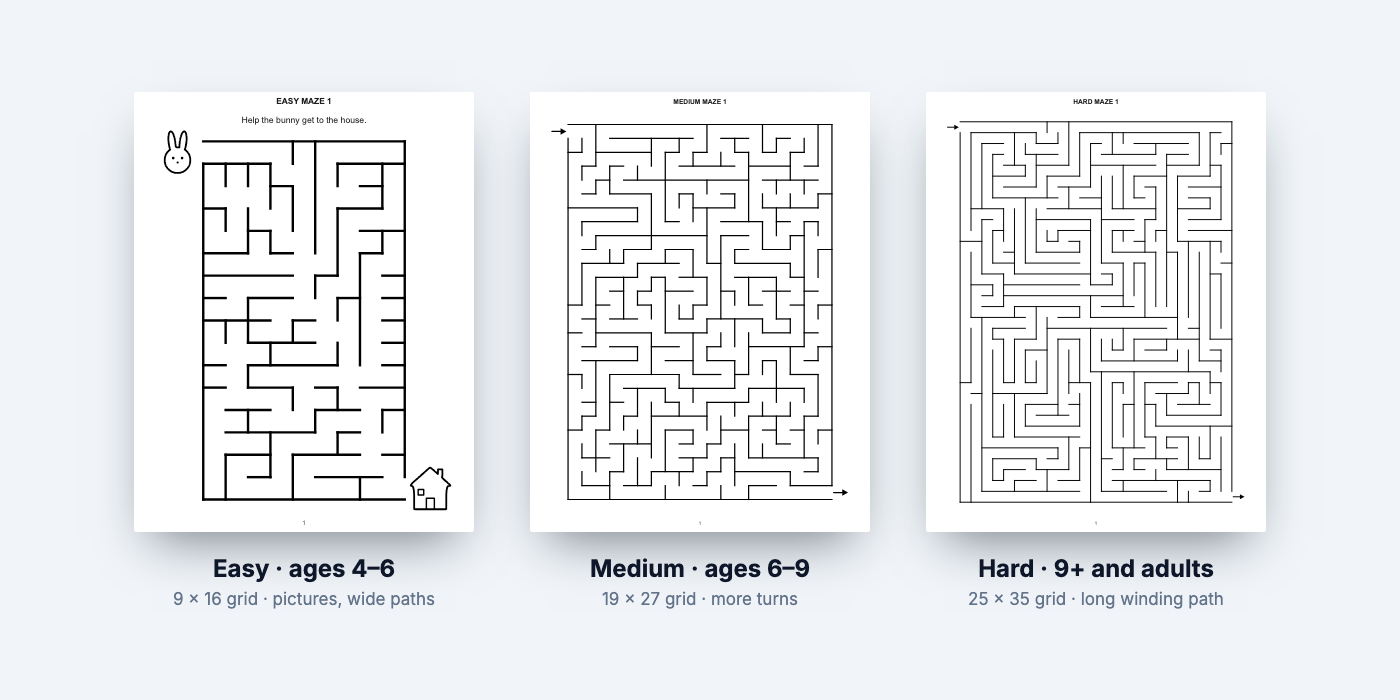
| Age | Maze size (US Letter page) | What helps |
|---|---|---|
| 4–6 | about 9 × 16 cells, wide paths | A picture at the start and finish, a one-line instruction |
| 6–9 | about 19 × 27 cells | Arrows, a few long dead ends |
| 9+ and adults | about 25 × 35 cells or more | Long corridors and a solution that doubles back |
The cell counts above are from our free printable sets. For young children, wide paths matter more than anything — a crayon needs room. Large print settings in a maze generator do this by using fewer, bigger cells on the same page.
What makes a maze harder?
Size is only part of it. Two mazes with the same number of cells can feel very different:
- Easy mazes have many short dead ends and a fairly direct solution. Wrong turns are found quickly.
- Hard mazes have long corridors and a solution that winds back on itself, so a wrong turn can take a while to notice.
For a book, ramp up: start with smaller, easier mazes and finish with the biggest. Reviewers of activity books often mention "progression" as something they liked.
Should you use shaped or circular mazes?
Shapes make a book feel different on the page and in the thumbnail. A maze inside a pumpkin, a Christmas tree or a dinosaur is an easy subtitle hook for a seasonal or themed book.
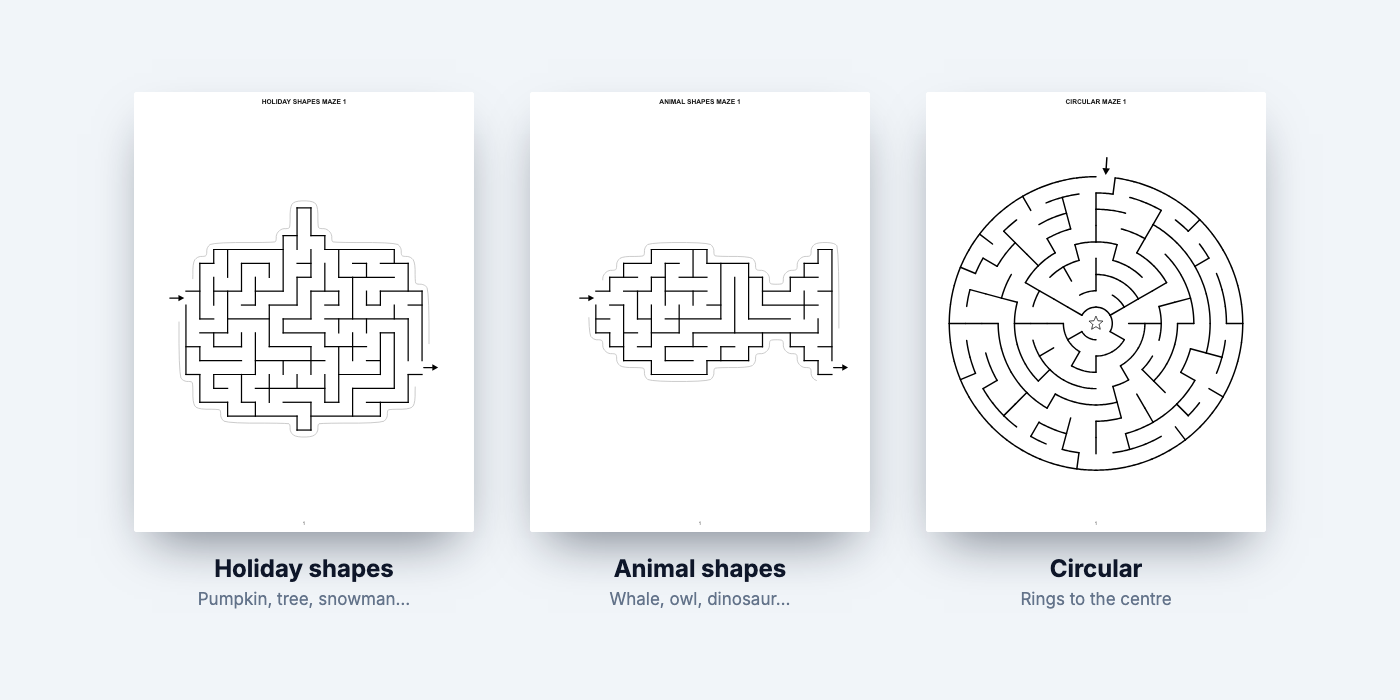
- Holiday shapes — pumpkin, Christmas tree, snowman, gift, bell, Easter egg — for seasonal books.
- Animal shapes — whale, turtle, owl, butterfly, dinosaur, elephant — for children's books.
- Circular mazes — rings that lead to the centre — feel more like a puzzle and suit older children and adults.
Keep the theme consistent with the title: a "Halloween maze book" should be mostly Halloween shapes, not a few among plain rectangles.
How do you add the solutions?
Put the solutions at the back, four to a page for a children's book or six to nine for an adult book, labelled with the same number as the maze. Draw the path in a clear, thick line.
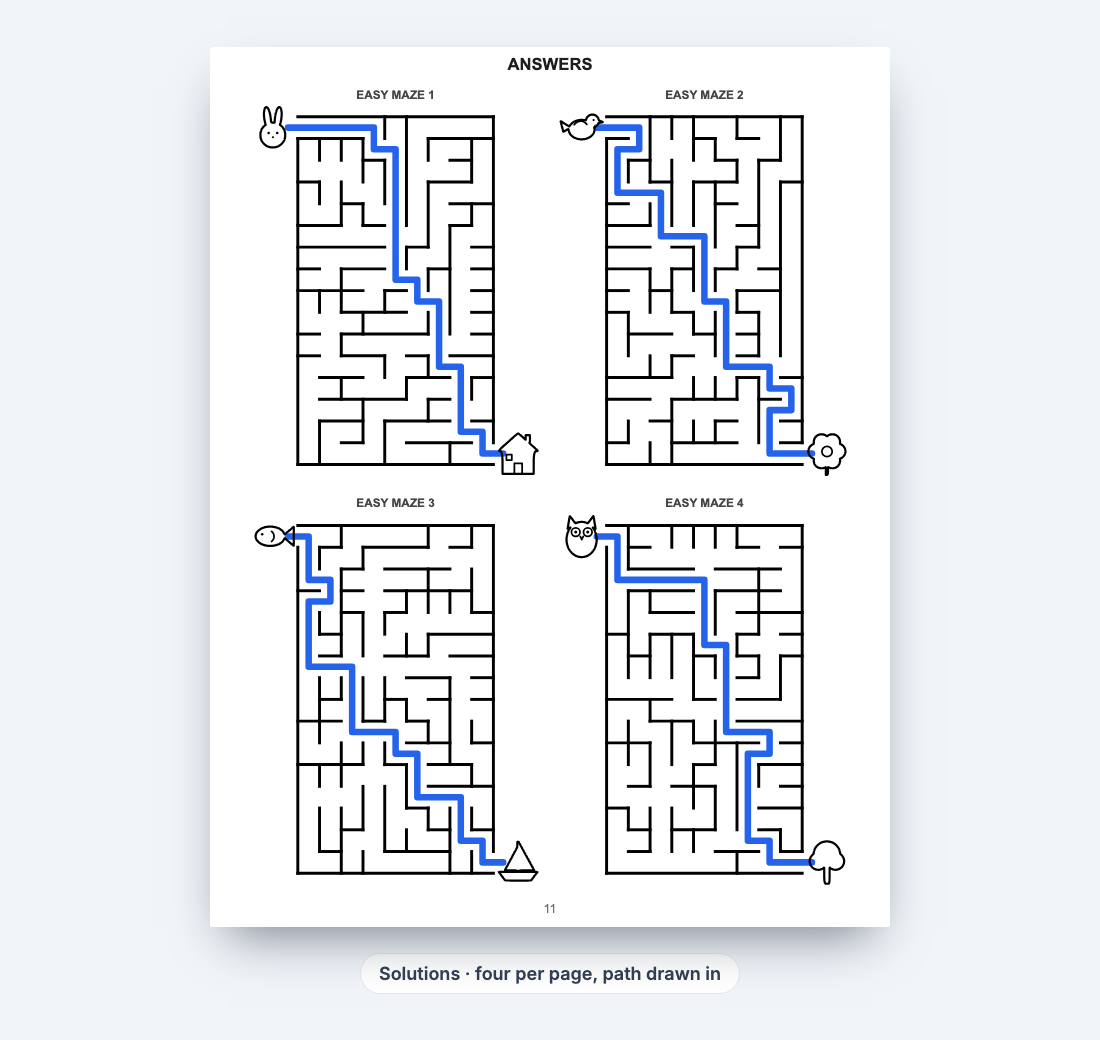
Every maze must have exactly one solution. In a "perfect" maze every cell can be reached and there is only one path between any two cells — a good generator guarantees this, so the solution page is always right.
What trim size, page count and price work for a maze book?
Two common formats, priced with Amazon.com's 2026 printing costs (black ink):
| Book | Pages | Printing | Royalty at lower price | Royalty at $9.99 |
|---|---|---|---|---|
| Kids, 8.5 × 11 in, 50 mazes, 1 per page, solutions 4 per page | about 67 | $2.84 | about $1.16 at $7.99 | about $3.15 |
| Adults, 6 × 9 in, 100 mazes, 1 per page, solutions 6 per page | about 119 | about $2.43 | about $2.07 at $8.99 | about $3.57 |
Below $9.99, KDP pays 50% of the list price instead of 60% — see KDP paperback royalties and the 50% rule. These are per-copy royalties, not a sales forecast; check your own numbers in the royalty calculator.
For children's books, 8.5 × 11 in gives the widest paths. For adult and travel books, 6 × 9 in is cheaper to print per page. Check margins in the trim size guide and size the cover with the spine width calculator once the page count is final.
How do you publish the maze book on KDP?
- Title and subtitle: say the age and the count — for example "Maze Book for Kids Ages 4–6: 50 Fun Mazes with Solutions".
- Low-content option or ISBN: activity books can be published as low-content, which makes the ISBN optional (but rules out Expanded Distribution).
- Upload the interior and cover PDFs and fix anything the previewer flags.
- Order a proof and try two mazes from different parts of the book with a crayon or pencil, not just your eyes.
- Description: state the age range, the number of mazes, one maze per page, and that solutions are included.
Theme research, cover design and keywords work the same way as for other puzzle books — see how to make a word search book for KDP.
Try the levels on paper first
Our free printable mazes page has 60 mazes in six sets — easy picture mazes, medium, hard, holiday shapes, animal shapes and circular — each with solutions. Printing one set is the quickest way to judge which level fits the age you have in mind.

When you are ready, the maze generator makes square and circular mazes in four sizes, three difficulty levels and 46 shapes, with picture markers and your own instruction line, and exports a KDP-ready PDF with solutions. It is free, and exports carry a commercial licence.
Maze book checklist
- One age group, named on the cover
- Maze size and difficulty matched to that age
- Mazes grow harder through the book
- Every maze has exactly one solution
- Solutions at the back, numbered like the mazes
- Page count and printing cost checked against the price
- Proof copy tested with a crayon or pencil
Frequently asked questions
What size maze is right for a 5 year old?
A small maze with wide paths — about 9 × 16 cells on a US Letter page — with a picture at the start and finish and a short instruction.
How many mazes should a maze book have?
Children's maze books often have 40–60 mazes, one per page. Adult maze books often have 100 or more.
Do maze books need solutions?
Yes. Buyers expect a solution section, and parents use it when a child is stuck. Put the solutions at the back, numbered like the mazes.
What is a perfect maze?
A maze in which every cell can be reached and there is exactly one path between any two cells, so there is exactly one way from the start to the finish.
What trim size is good for a kids maze book?
8.5 × 11 in with one maze per page gives the widest paths for crayons and small hands.
Where can I get free printable mazes?
DT Labs has 60 free printable mazes at dtlabs.app/printable-mazes in six sets from easy picture mazes to hard and circular mazes, each with solutions.
Christmas Activities for Seniors: Large Print Puzzles, Bingo and Carols
Christmas activities for seniors at home, in care homes and in church groups — large print Christmas word searches, bingo, carol cryptograms, crosswords and ornament coloring pages, with free printables and answers.
Nov 2, 2026 · 4 min read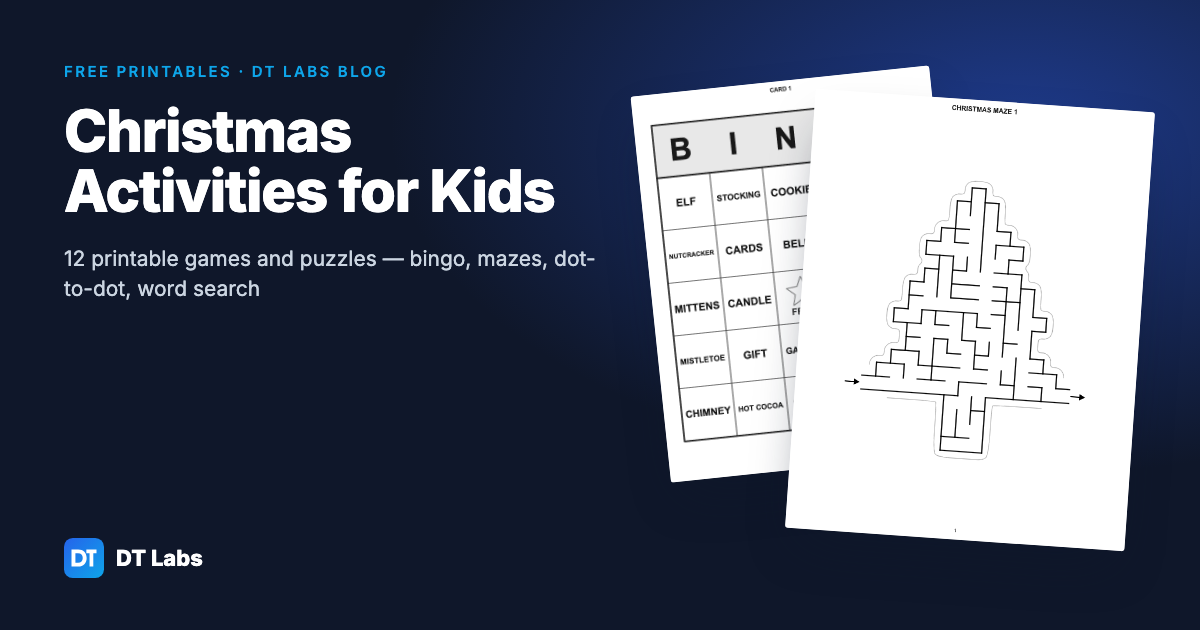
Christmas Activities for Kids: 12 Printable Games and Puzzles
Twelve Christmas activities for kids at home and in the classroom — word searches, bingo, tree and snowman mazes, dot-to-dots, crosswords and an advent puzzle calendar — with free printables and answers.
Nov 2, 2026 · 4 min read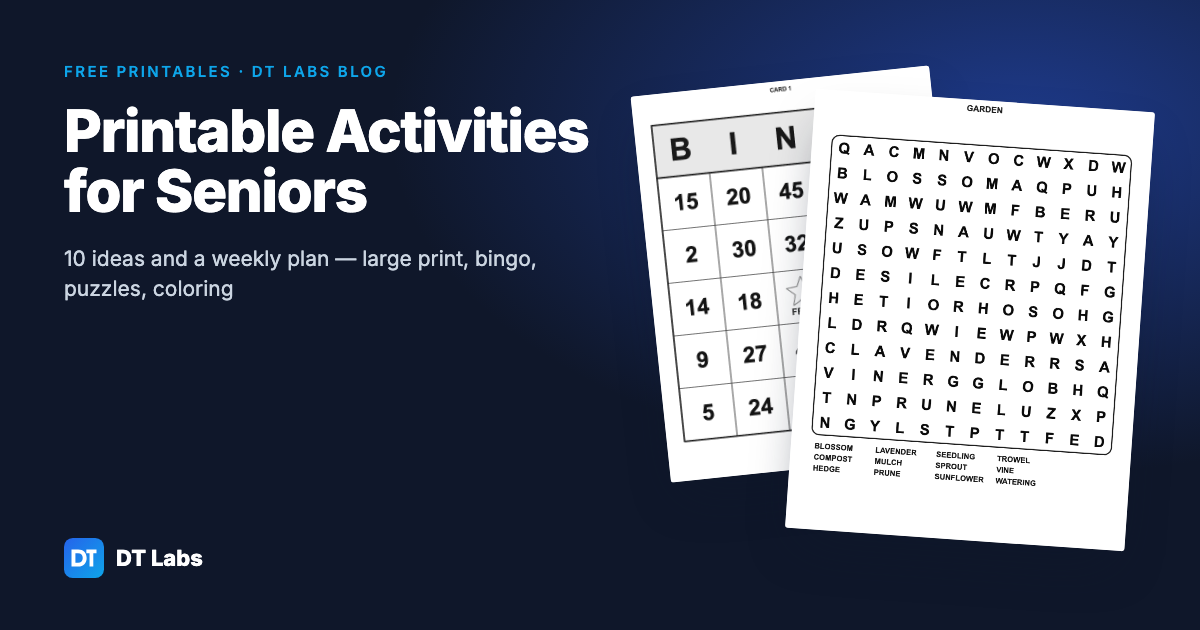
Printable Activities for Seniors: 10 Ideas and a Weekly Plan
Ten printable activities for seniors at home, in care homes and in community groups — large print word searches, bingo, easy sudoku, proverb cryptograms, crosswords and coloring — plus a simple weekly plan, all free to print.
Nov 2, 2026 · 4 min read