
How to Make a Mathdoku Book for KDP (Calcudoku Puzzles)
Make a Mathdoku (Calcudoku) book for Amazon KDP: grid sizes, which operations to use, one solution per puzzle, expert mode, answers, trim size and price.
By Dau Le · · 5 min read
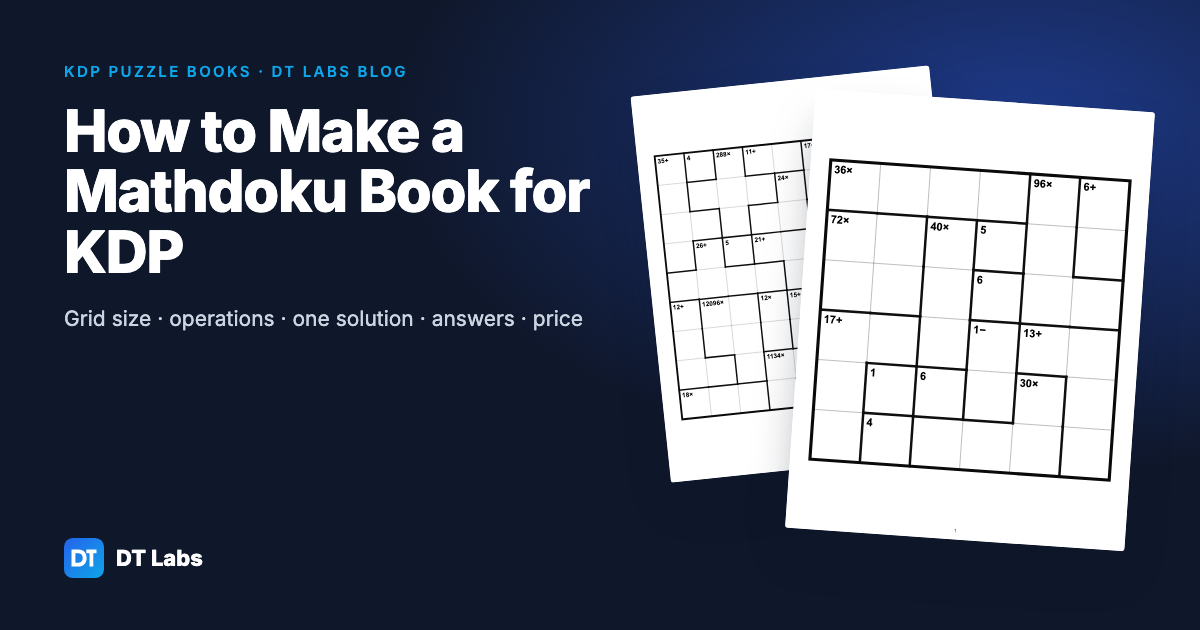
Mathdoku — also printed as Calcudoku or arithmetic cage puzzles — mixes the row-and-column rule of sudoku with simple sums. That makes it popular with two very different buyers: adults who want a number puzzle that is not sudoku, and parents and teachers who want arithmetic practice that feels like a game. This guide covers how to make a Mathdoku book for Amazon KDP: grid size, operations, one solution per puzzle, expert mode, answers, trim size and price.
In short: pick one audience, choose the grid size and operations for it, make sure every puzzle has exactly one solution reachable by logic, put the answers at the back, and check the page count against the printing cost before you set a price. You can try three sizes on paper with our free printable Mathdoku puzzles.
What do you need to make a Mathdoku book?
A Mathdoku generator that builds the grid, draws the cages, sets each cage's target and checks the puzzle can be solved by logic with only one answer; a cover sized to your page count; and a free KDP account. The DT Labs Mathdoku generator does this in your browser and makes the answer pages.
How do you play Mathdoku?
Fill a grid of size N with the numbers 1 to N so each number appears once in every row and column. Heavy outlines mark cages; the digits in a cage combine with the operation shown to make the number in its corner. Subtraction and division cages have two squares, in either order. One-square cages give their digit away — a good place to start.
Put these rules on an instructions page at the front of the book, with a small worked example if you have room.
Which grid size and operations suit your reader?

| Reader | Grid | Operations |
|---|---|---|
| Children 7–9, first try | 3 × 3 or 4 × 4 | + only, or + and − |
| Children 9–12, classrooms | 4 × 4 to 6 × 6 | + − × |
| Adults, beginners | 5 × 5 or 6 × 6 | + − × ÷ |
| Adults, experienced | 7 × 7 to 9 × 9 | + − × ÷ |
For a children's book, the operations are the point: a "+ and − only" book is arithmetic practice, and a "× and ÷" book practises times tables. Say which in the subtitle. Division cages appear only where the division comes out even.
How is difficulty set?
Cage size sets the difficulty. Easy puzzles have many one- and two-square cages; hard puzzles have cages of three to five squares and few one-square starts. Ramp from easy to hard through the book.
Why must every Mathdoku have one solution?
With cages of sums and products, it is easy to build a grid where two fillings fit all the clues. The solver then reaches a point where nothing can be reasoned out. A generator should solve each puzzle the way a person does — no trial and error — and change the cages until logic fills every square. That proves the puzzle has exactly one solution. The DT Labs generator does this for every puzzle, and our tests confirm it with a separate brute-force count.
What is expert mode?
In expert mode the cages show only the target number, not the operation — the solver must work out whether "12" is a sum or a product. It is a good final section for an adult book, or a book of its own for experienced solvers.

How do you add the answers?
Put the filled grids at the back, four to nine per page, numbered like the puzzles. Printing the cage outlines and targets on the answer grids helps solvers find where they went wrong.
What trim size, page count and price work for a Mathdoku book?
Small grids pack well; 7 × 7 and larger need a bigger page. Two example formats, priced with Amazon.com's 2026 printing costs (black ink):
| Book | Pages | Printing | Royalty at lower price | Royalty at $9.99 |
|---|---|---|---|---|
| 6 × 9 in, 100 puzzles 2 per page, answers 9 per page | about 65 | $2.30 | about $1.70 at $7.99 | about $3.69 |
| Large print 8.5 × 11 in, 100 puzzles 1 per page, answers 4 per page | about 128 | about $3.18 | about $1.32 at $8.99 | about $2.82 |
Below $9.99, KDP pays 50% of the list price instead of 60% — see KDP paperback royalties and the 50% rule. These are per-copy royalties, not a sales forecast; check your own numbers in the royalty calculator and size the cover with the spine width calculator.
How do you publish the Mathdoku book on KDP?
- Title and subtitle: use the generic names — Mathdoku, Calcudoku, math logic puzzles — and say the sizes. Do not use other companies' puzzle brand names in the title, subtitle or keywords.
- Low-content option or ISBN: puzzle books can be published as low-content, which makes the ISBN optional (but rules out Expanded Distribution).
- Upload the interior and cover PDFs and fix anything the previewer flags.
- Order a proof and solve an easy and a hard puzzle.
- Description: give the grid sizes, the operations, the number of puzzles, that each has one solution and that answers are included.
For more on ramps and answer layout, see how to make a sudoku book for KDP; for arithmetic drills rather than puzzles, see how to make a math workbook.
Try the sizes on paper first
Our free printable Mathdoku puzzles page has 30 puzzles — easy 4 × 4 with + and −, medium 6 × 6 and hard 8 × 8 with all four operations — each with exactly one solution and answers at the back. For another sum-based puzzle, see free printable kakuro and how to make a kakuro book.
When you are ready, the Mathdoku generator makes puzzles from 3 × 3 to 9 × 9 with + only, + −, + − × or all four operations, an expert mode with the operations hidden, an easy-to-hard ramp and one to six puzzles per page, and exports a KDP-ready PDF with solutions. It is free, and exports carry a commercial licence.
Mathdoku book checklist
- One audience; grid size and operations chosen for it
- Every puzzle solvable by logic with exactly one solution
- Rules and an example on the instructions page
- Puzzles ramp from easy to hard
- Generic puzzle names only — no other brands' puzzle names
- Answers at the back, numbered like the puzzles
- Page count and printing cost checked against the price
Frequently asked questions
Is Mathdoku the same as Calcudoku?
Yes. The same arithmetic cage puzzle is printed under several names, including Mathdoku and Calcudoku. The rules are the same.
What size Mathdoku is good for kids?
3 × 3 or 4 × 4 with + only or + and −. Children around 9 to 12 can move on to 5 × 5 or 6 × 6 with multiplication.
Does every Mathdoku have one solution?
A well-made one does. Check each puzzle with a solver that uses logic only; if it fills every square, the puzzle has exactly one solution.
What is a Mathdoku with hidden operations?
An expert version where each cage shows only its target number, so the solver must work out which operation was used.
How many Mathdoku puzzles fit on a page?
One per page for large print or 7 × 7 and larger, two for 5 × 5 and 6 × 6, and four to six for 3 × 3 and 4 × 4.
Where can I get free printable Mathdoku puzzles?
DT Labs has 30 free printable Mathdoku puzzles with answers at dtlabs.app/printable-mathdoku, in 4 × 4, 6 × 6 and 8 × 8.
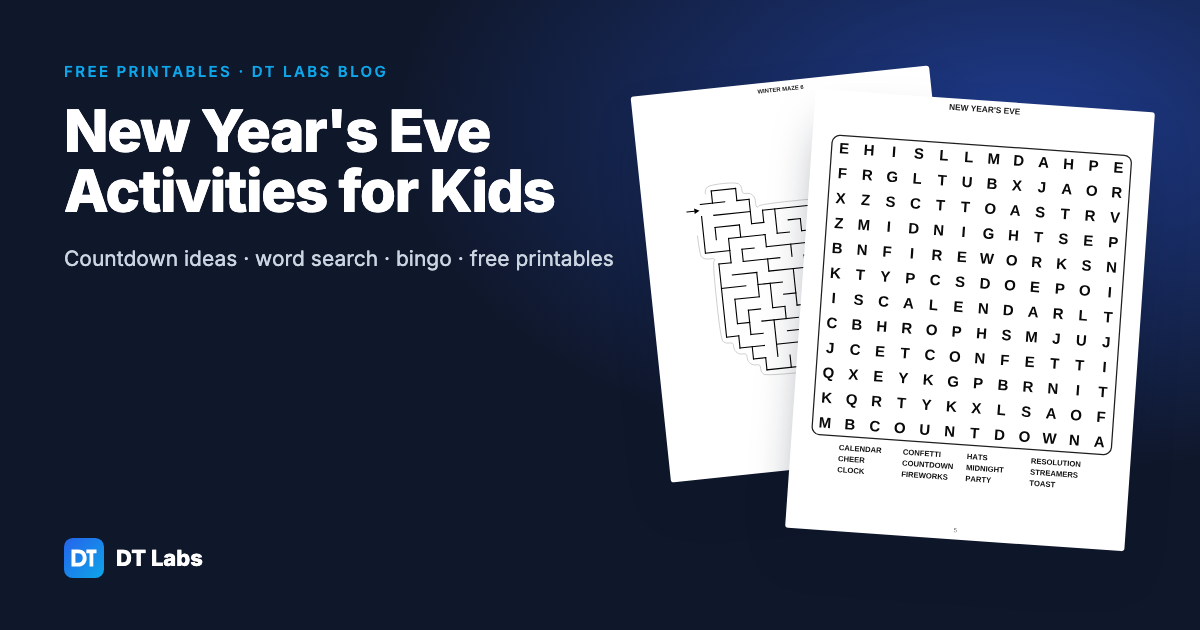
New Year's Eve Activities for Kids: 10 Ideas with Free Printables
Ten New Year's Eve activities for kids — countdown bags, a noon countdown for little ones, New Year word searches, bingo, mazes, coloring and code-breaking — with free printables.
Nov 1, 2026 · 4 min read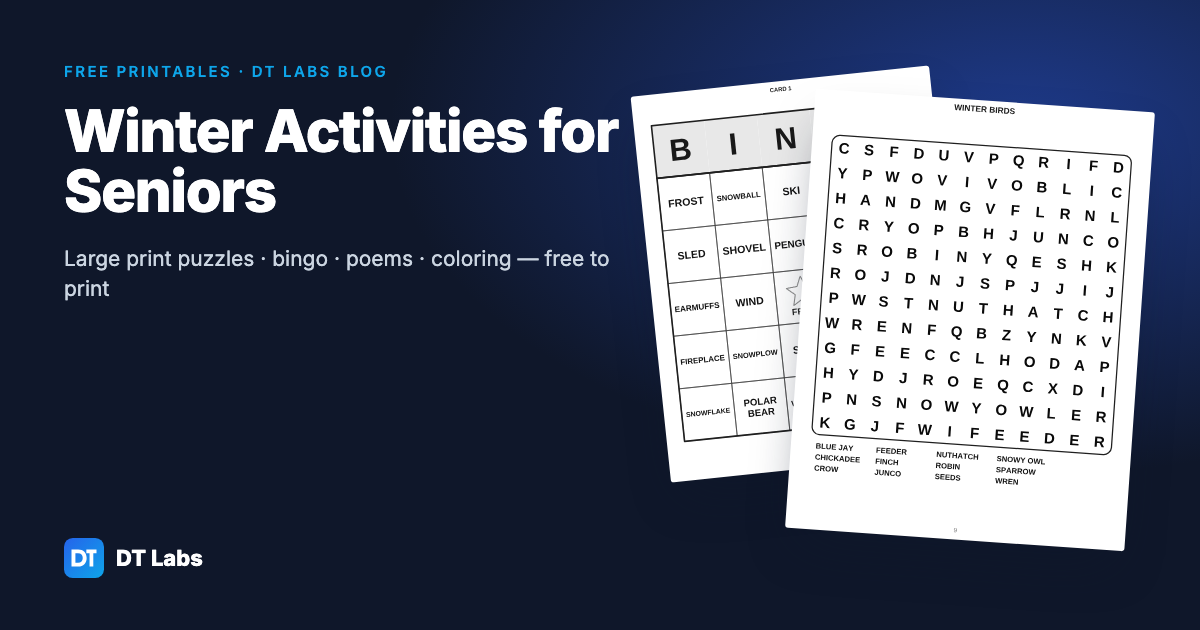
Winter Activities for Seniors: 8 Ideas with Free Large Print Printables
Eight winter activities for seniors at home, in care homes and in groups — large print word searches, winter bingo, poem cryptograms, coloring and more, with free printables.
Nov 1, 2026 · 5 min read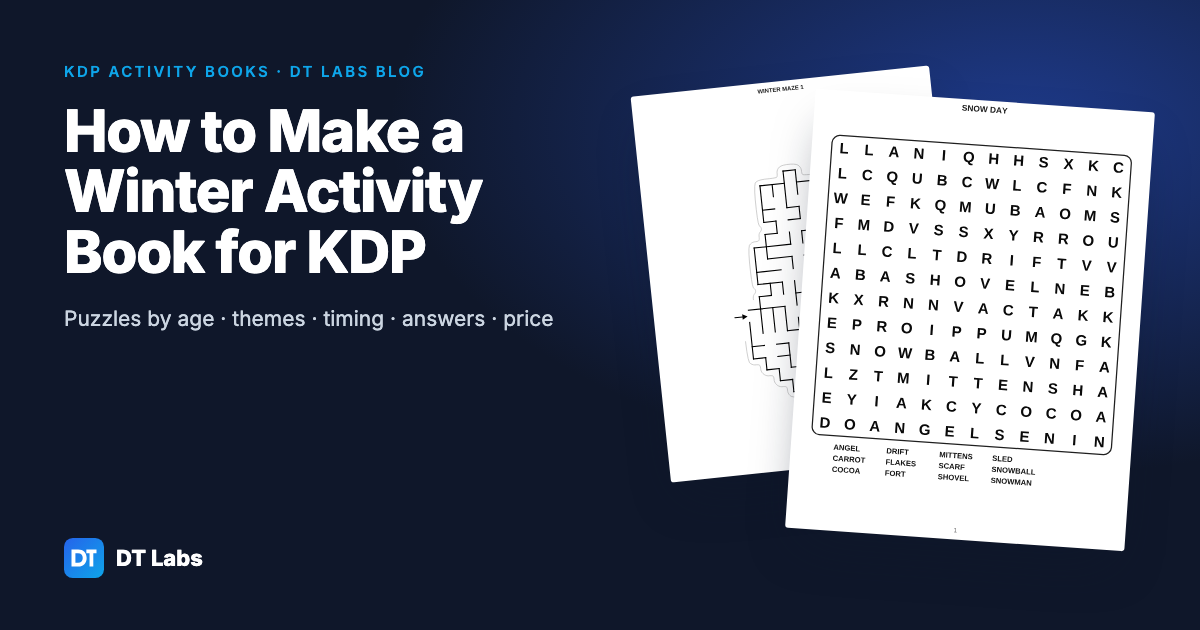
How to Make a Winter Activity Book for KDP (That Sells Past Christmas)
Make a winter activity book for Amazon KDP: which puzzles suit each age, winter themes that last from December to February, when to publish, answer pages, trim size and price.
Nov 1, 2026 · 5 min read