
How to Make a Kakuro Book for KDP (Cross Sums)
Make a kakuro (cross sum) book for Amazon KDP: grid sizes, why each puzzle needs one solution, the combination chart, answers, trim size and price.
By Dau Le · · 5 min read
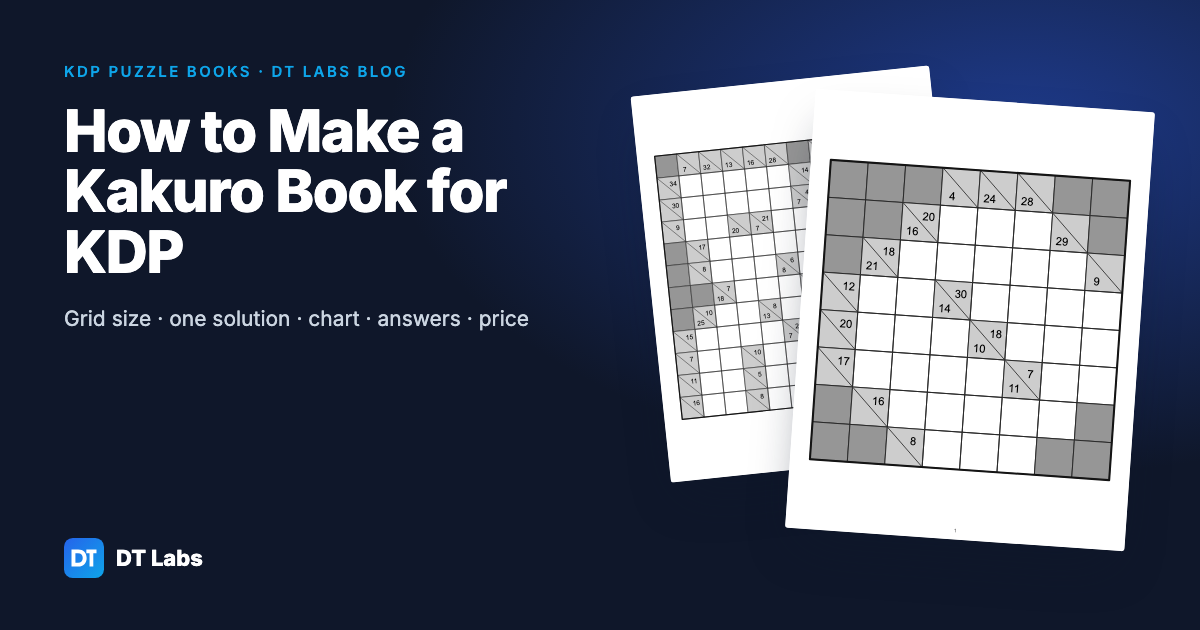
Kakuro — cross sums — is the number puzzle for people who like sudoku and arithmetic at the same time. Its solvers are experienced and exacting: a kakuro with two answers, or one that can only be finished by guessing, gets returned. A good kakuro book also includes something sudoku books do not: a combination chart. This guide covers how to make a kakuro book for Amazon KDP, from grid size to price.
In short: pick grid sizes and a difficulty range for your reader, make sure every puzzle has exactly one solution, include a combination chart at the front, put the answers at the back, and check the page count against the printing cost before you set a price. You can try three sizes on paper with our free printable kakuro puzzles.
What do you need to make a kakuro book?
A kakuro generator that builds grids, sets the clue totals and checks each puzzle has exactly one solution; a cover sized to your page count; and a free KDP account. The DT Labs kakuro generator does this in your browser, adds the combination chart and makes the answer pages.
What grid sizes suit which solvers?
Kakuro sizes include the clue row along the top and the clue column down the left, so an 8 × 8 kakuro has seven rows and columns to fill below and beside them.
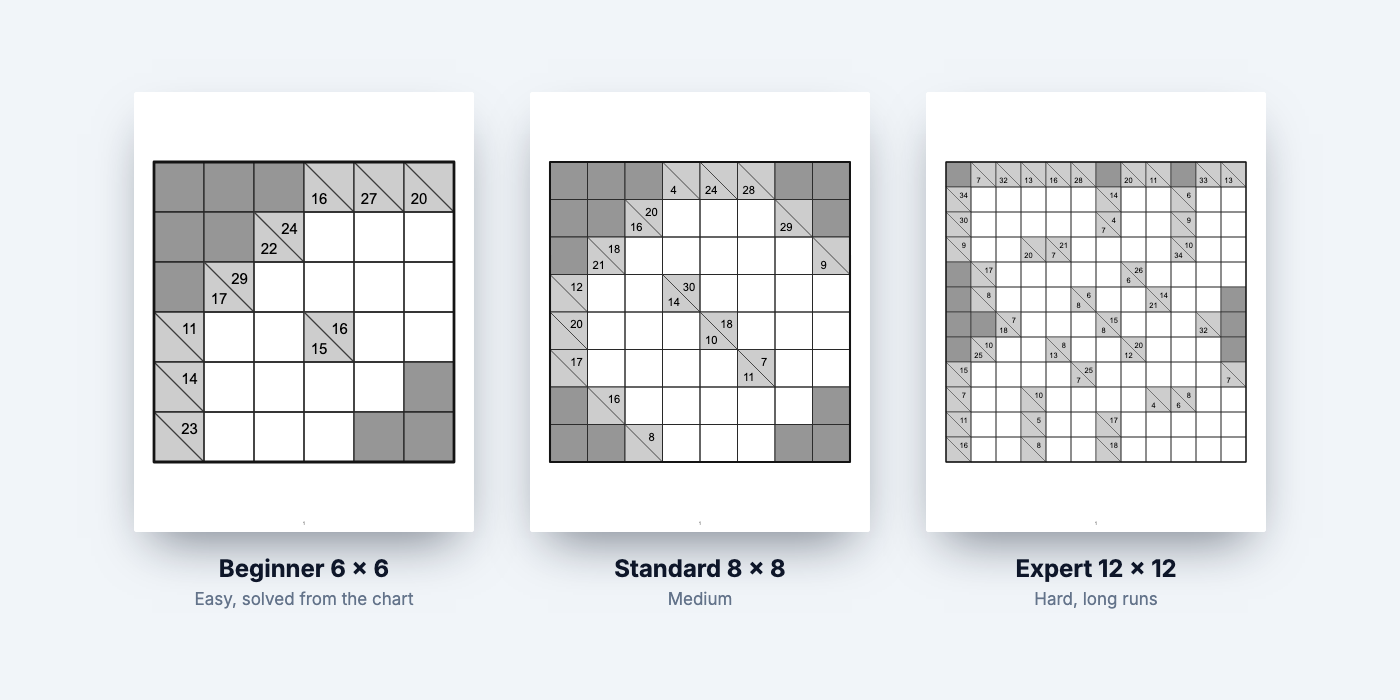
| Grid | Difficulty | Solver |
|---|---|---|
| 6 × 6 | Easy | A first kakuro; can be solved almost entirely from the chart |
| 8 × 8 | Medium | Most solvers; the standard book size |
| 10 × 10 | Medium–hard | Regular solvers |
| 12 × 12 | Hard | Experienced solvers; long runs |
Many kakuro books run from 8 × 8 to 12 × 12 and ramp from easy to hard. Difficulty is not only size: hard puzzles have longer runs and totals that can be made from many digit sets, so less can be filled in from the chart alone.
Why must every kakuro have exactly one solution?
A kakuro is solved by reasoning about which digits can make each total. If two different fillings fit the clues, the solver reaches a point where nothing can be worked out and must guess — and the answer page may not match their (equally correct) grid.
A generator should count solutions for every puzzle and adjust the grid until exactly one is left. The DT Labs generator does this, then checks again with a larger search, so every puzzle in your book can be finished by logic.
What is the combination chart, and why include it?
Some totals can be made from only one set of digits. Two squares adding to 3 must be 1 and 2; three squares adding to 24 must be 7, 8 and 9. Those are where a solver starts.
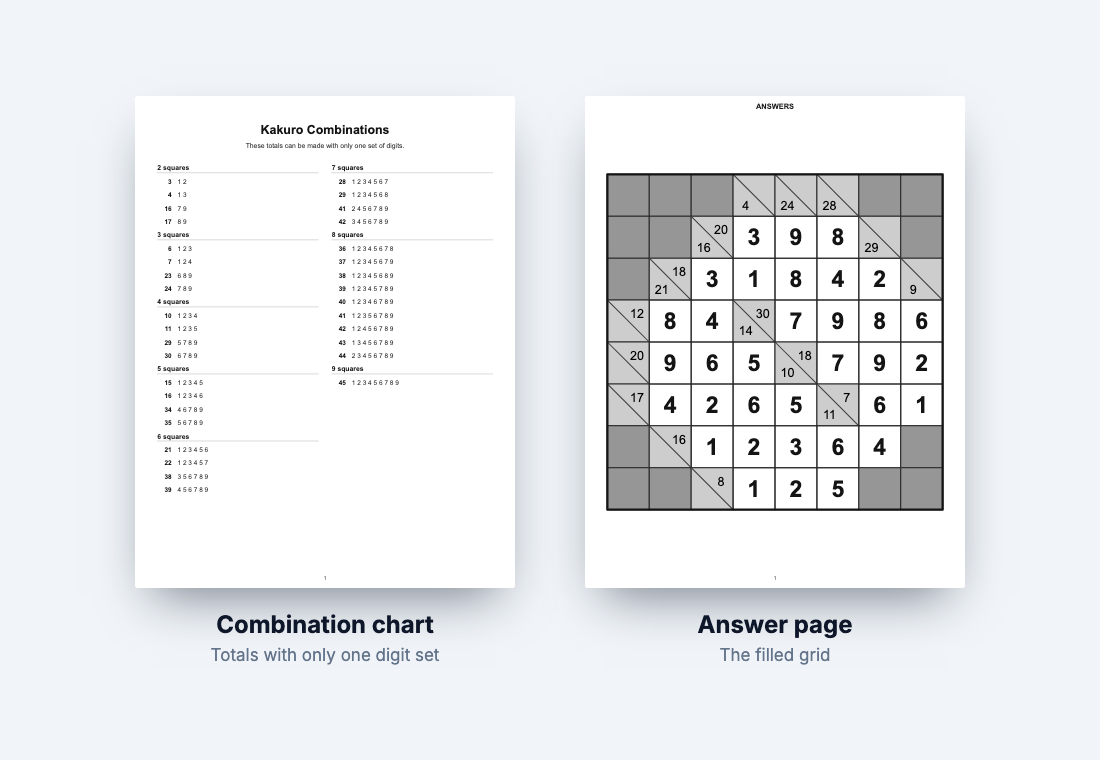
A chart at the front of the book lists every such total for runs of two to nine squares, plus all the digit sets for runs of two and three. Experienced solvers expect it; beginners need it. It is two pages that make a book feel complete.
How many kakuro should go on a page?
- One per page on 8.5 × 11 in: large print, or for 10 × 10 and 12 × 12 grids.
- Two per page on 6 × 9 in or 8.5 × 11 in: standard 8 × 8 books.
- Four or six per page: small 6 × 6 grids for compact books.
Clue numbers sit in half-squares, so they get small quickly. Print one page at home before choosing — see trim size for puzzle books for how page size affects print size.
How do you add the answers?
Put the filled grids at the back, four to six per page, numbered like the puzzles. Because the answers come from the same grid as the clues, and each puzzle has one solution, they always match the solver's grid.
What trim size, page count and price work for a kakuro book?
Two example formats, each with a title page, instructions and a two-page combination chart, priced with Amazon.com's 2026 printing costs (black ink):
| Book | Pages | Printing | Royalty at lower price | Royalty at $9.99 |
|---|---|---|---|---|
| 6 × 9 in, 100 puzzles 2 per page, answers 6 per page | about 71 | $2.30 | about $1.70 at $7.99 | about $3.69 |
| Large print 8.5 × 11 in, 100 puzzles 1 per page, answers 4 per page | about 129 | about $3.19 | about $1.30 at $8.99 | about $2.80 |
Below $9.99, KDP pays 50% of the list price instead of 60% — see KDP paperback royalties and the 50% rule. These are per-copy royalties, not a sales forecast; check your own numbers in the royalty calculator and size the cover with the spine width calculator.
How do you publish the kakuro book on KDP?
- Title and subtitle: use both names — for example "Kakuro Puzzle Book: 100 Cross Sums, Easy to Hard, 8×8 to 12×12, with Combination Chart and Solutions".
- Low-content option or ISBN: puzzle books can be published as low-content, which makes the ISBN optional (but rules out Expanded Distribution).
- Upload the interior and cover PDFs and fix anything the previewer flags.
- Order a proof and solve an easy and a hard puzzle. Check that clue numbers are readable.
- Description: give the sizes, the difficulty range, the number of puzzles, that each has one solution, and that the chart and answers are included.
Ramp and answer layout work the same way as in a sudoku book — see how to make a sudoku book for KDP.
Try the sizes on paper first
Our free printable kakuro puzzles page has 30 puzzles — beginner 6 × 6, medium 8 × 8 and hard 10 × 10 — each with the combination chart at the front and answers at the back. For another arithmetic logic puzzle, see our free printable Mathdoku puzzles.
When you are ready, the kakuro generator makes kakuro from 6 × 6 to 12 × 12 in three difficulty levels, with an easy-to-hard ramp, the combination chart and one to six puzzles per page, and exports a KDP-ready PDF with solutions. It is free, and exports carry a commercial licence.
Kakuro book checklist
- Grid sizes and difficulty range named in the subtitle
- Every puzzle checked to have exactly one solution
- Combination chart at the front
- Clue numbers readable at your trim size
- Puzzles ramp from easy to hard
- Answers at the back, numbered like the puzzles
- Page count and printing cost checked against the price
Frequently asked questions
What is the difference between kakuro and cross sums?
None — cross sums is another name for kakuro. Using both in a title or subtitle helps buyers who search for either.
What size kakuro is good for beginners?
6 × 6 on easy, which can be solved almost entirely from the combination chart. 8 × 8 is the usual next step.
What is a kakuro combination chart?
A list of totals that can be made from only one set of digits — such as 3 in two squares (1 and 2) or 24 in three (7, 8 and 9) — that solvers use to find their first sure squares.
Does every kakuro have only one solution?
A well-made one does. Check each puzzle with a solver that counts solutions and keep only those with exactly one.
How many kakuro should go on a page?
One per page for large print or big grids, two per page for standard 8 × 8 books, and four to six for small 6 × 6 grids.
Where can I get free printable kakuro puzzles?
DT Labs has 30 free printable kakuro puzzles with a combination chart and answers at dtlabs.app/printable-kakuro.
New Year's Eve Activities for Kids: 10 Ideas with Free Printables
Ten New Year's Eve activities for kids — countdown bags, a noon countdown for little ones, New Year word searches, bingo, mazes, coloring and code-breaking — with free printables.
Nov 1, 2026 · 4 min read
Winter Activities for Seniors: 8 Ideas with Free Large Print Printables
Eight winter activities for seniors at home, in care homes and in groups — large print word searches, winter bingo, poem cryptograms, coloring and more, with free printables.
Nov 1, 2026 · 5 min read
How to Make a Winter Activity Book for KDP (That Sells Past Christmas)
Make a winter activity book for Amazon KDP: which puzzles suit each age, winter themes that last from December to February, when to publish, answer pages, trim size and price.
Nov 1, 2026 · 5 min read