
How to Make a Dot-to-Dot Book for KDP (Kids to Adults)
Make a dot-to-dot book for Amazon KDP: how many dots for each age, numbers, letters or skip counting, choosing pictures, answer pages, trim size and price.
By Dau Le · · 5 min read
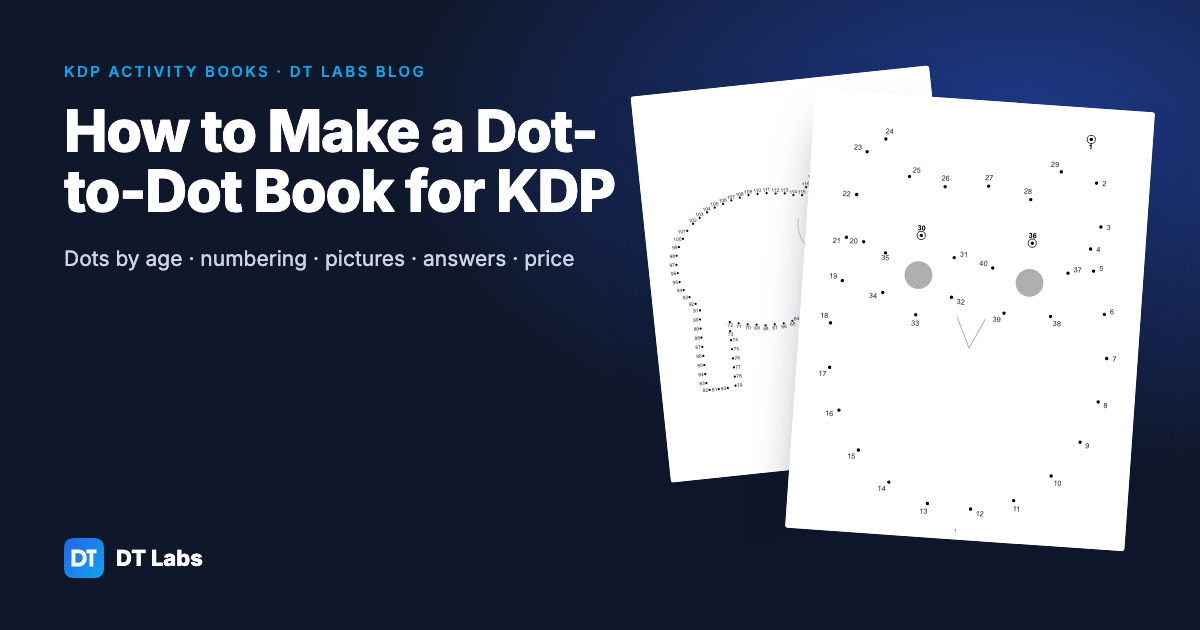
Dot-to-dot books look like the simplest activity book to make — and the details are exactly what reviewers notice. Numbers printed on top of dots, two dots so close together that a child cannot tell which comes next, 80 dots in a book labelled "ages 3–5", or a picture nobody can recognise at the end. This guide covers how to make a dot-to-dot book for Amazon KDP: dots by age, numbering, pictures, answer pages, trim size and price.
In short: pick one age group, match the number of dots to it, keep every dot and number clear of the others, use pictures children recognise, add answer pages with the finished pictures, and check the page count against the printing cost before you set a price. You can see five levels on paper with our free printable dot-to-dot pages.
What do you need to make a dot-to-dot book?
A dot-to-dot maker that places numbered dots along a picture's outline so that no two dots overlap and no number sits on a dot; a set of pictures; a cover sized to your page count; and a free KDP account. The DT Labs dot-to-dot maker does this in your browser from 45 built-in pictures or your own silhouette, and makes the answer pages.
How many dots suit each age?
The number of dots is the difficulty setting of a dot-to-dot book.
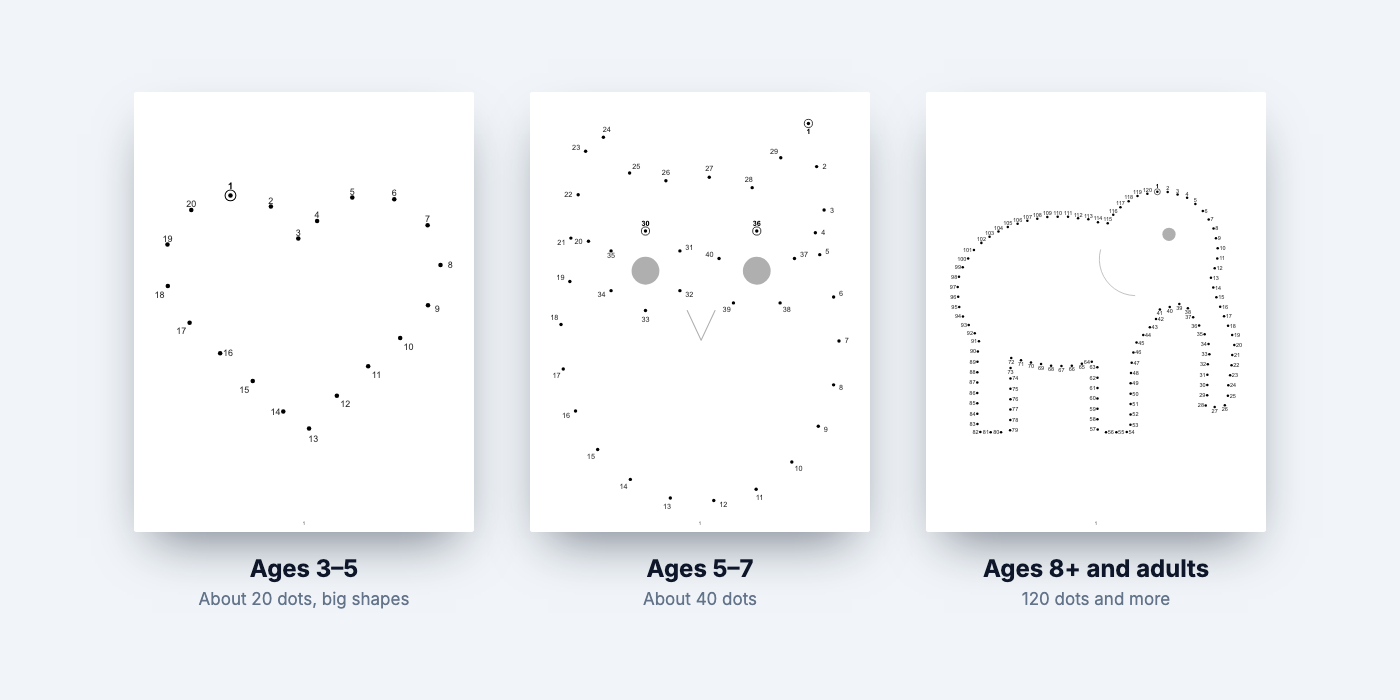
| Age | Dots per page | What helps |
|---|---|---|
| 3–5 | 10–30 | Big, simple shapes; large numbers; one line |
| 5–7 | 30–60 | Animals and things they know |
| 7–10 | 60–150 | More detail, a few inner lines |
| 10+ and adults | 150–300 ("extreme") | Detailed pictures; small print is fine |
For a children's book, ramp up: start each book with fewer dots and add more page by page, so the first pages build confidence.
What about pictures with inner lines?
Detailed pictures have more than one line — the shell of a turtle, a window, a wing. Each new line starts at a ringed dot with a bold number, and the counting continues from where the last line stopped. Explain this once on the instructions page. Light inner lines printed on the page (eyes, stripes) help the picture look finished and turn it into a colouring page.
Numbers, letters or skip counting?
Numbering turns a dot-to-dot into a learning book, and it is an easy way to stand out.
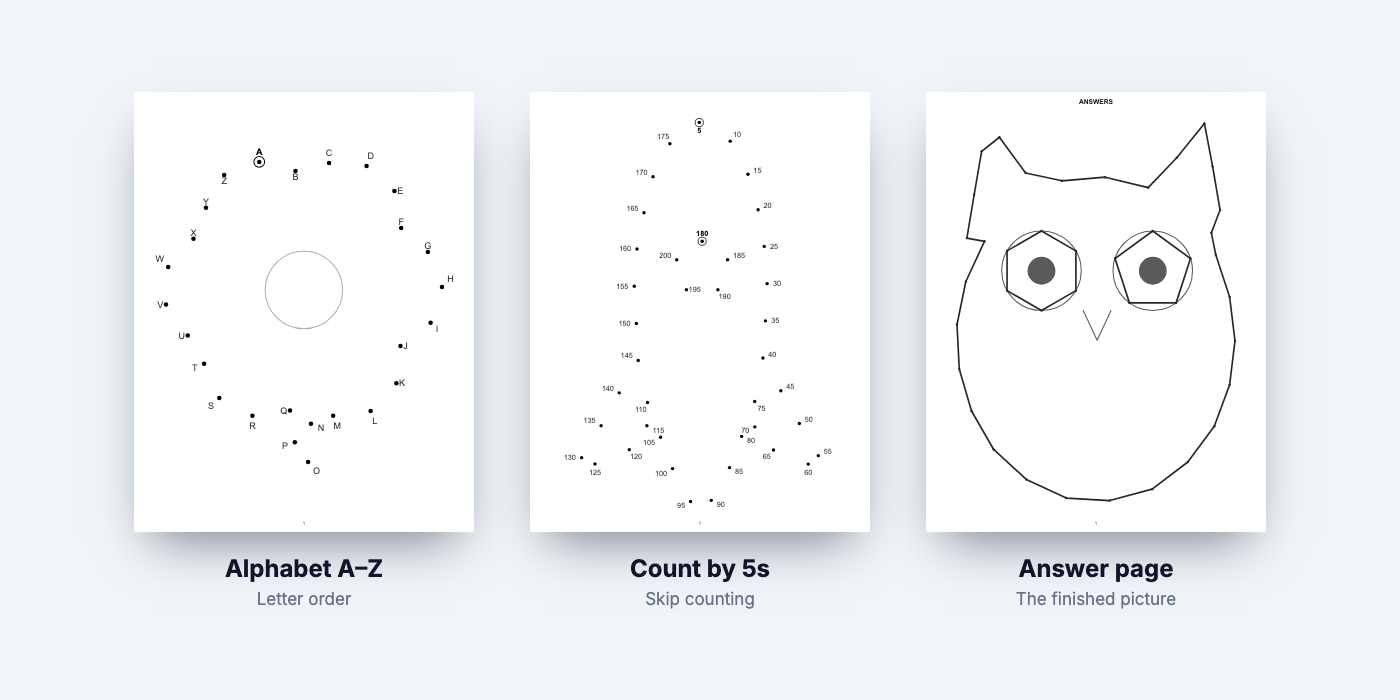
- 1, 2, 3 — the classic; fine for every age.
- A to Z — alphabet practice for ages 4–6 (at most 26 dots per picture).
- Count by 2s, 5s or 10s — skip-counting practice for ages 6–8; parents and teachers search for this.
- Roman numerals — a novelty for older children (up to 50).
A whole book in one numbering style is easier to describe: "Alphabet Dot-to-Dot for Preschool" or "Skip Counting Dot-to-Dot, Grades 1–2".
How do you choose pictures?
- Things children recognise from the outline alone: animals, vehicles, food, holiday objects.
- Your own pictures: a clear silhouette on a plain background traces cleanly. Use only images you made or have the right to use — no characters, mascots or logos.
- A theme for the whole book gives it a title and a cover: animals, dinosaurs, vehicles, Christmas.
Avoid pictures whose outline is just a blob at low dot counts — a bear at 20 dots may look like a cloud. Save detailed pictures for higher counts.
How do you add the answers?
Answer pages show each finished picture, labelled with the page number. Four to a page works for most books. They help parents when a child is stuck, and they let older children check their work.
What trim size, page count and price work for a dot-to-dot book?
Children's dot-to-dot books are almost always 8.5 × 11 in, one picture per page. If children will colour the pictures with markers, consider leaving the backs blank so ink does not show through — it doubles the puzzle pages, which changes the printing cost. Two example formats, priced with Amazon.com's 2026 printing costs (black ink):
| Book | Pages | Printing | Royalty at lower price | Royalty at $9.99 |
|---|---|---|---|---|
| 50 pictures, 1 per page, answers 4 per page | about 66 | $2.84 | about $1.16 at $7.99 | about $3.15 |
| 50 pictures with blank backs, answers 4 per page | about 116 | about $2.97 | about $1.52 at $8.99 | about $3.02 |
Below $9.99, KDP pays 50% of the list price instead of 60% — see KDP paperback royalties and the 50% rule. These are per-copy royalties, not a sales forecast; check your own numbers in the royalty calculator and size the cover with the spine width calculator.
How do you publish the dot-to-dot book on KDP?
- Title and subtitle: say the age, the dots and the theme — for example "Dot-to-Dot for Kids Ages 4–8: 50 Animal Connect the Dots Puzzles, 20 to 60 Dots, with Answers".
- Low-content option or ISBN: activity books can be published as low-content, which makes the ISBN optional (but rules out Expanded Distribution).
- Upload the interior and cover PDFs and fix anything the previewer flags.
- Order a proof and join the dots on one easy and one hard page with a pencil: can you always find the next number?
- Description: give the age range, dots per page, the numbering style, the number of pictures and that answers are included.
Dot-to-dot books sit well next to maze and handwriting books for the same ages — see how to make a maze book for KDP and how to make a handwriting practice book.
Try the levels on paper first
Our free printable dot-to-dot pages have 50 pictures in five sets — easy shapes, animals, alphabet A–Z, count by 2s and a 120-dot challenge — each with answer pages. The Christmas printables page has a holiday set too.
When you are ready, the dot-to-dot maker makes pages with 10 to 300 dots from 45 pictures or your own image, numbered 1–2–3, A–Z, by 2s, 5s or 10s or in Roman numerals, with light inner lines for colouring, and exports a KDP-ready PDF with answer pages. It is free, and exports carry a commercial licence.
Dot-to-dot book checklist
- One age group, named on the cover
- Dots per page matched to that age, more dots later in the book
- No dot or number overlapping another
- Pictures children recognise, no characters or logos
- One numbering style per book or section
- Answer pages with the finished pictures
- Page count and printing cost checked against the price
Frequently asked questions
How many dots should a dot-to-dot have for a 4 year old?
About 10 to 30 dots, on a big simple shape with large numbers and a single line.
What is an extreme dot-to-dot?
A dot-to-dot with about 150 to 300 or more dots and a detailed picture, made for older children and adults.
Can dot-to-dot pages teach counting?
Yes. Numbering the dots by 2s, 5s or 10s practises skip counting, and A to Z practises the alphabet.
Do dot-to-dot books need answer pages?
They are not required, but buyers like them: they show the finished picture when a child is stuck. Put them at the back, four to a page.
What trim size is good for a kids dot-to-dot book?
8.5 × 11 in with one picture per page, so the numbers are large and there is room for small hands.
Where can I get free printable dot-to-dot pages?
DT Labs has 50 free printable dot-to-dot pages with answers at dtlabs.app/printable-dot-to-dot, from 20-dot pictures for preschoolers to a 120-dot challenge set.
Christmas Activities for Seniors: Large Print Puzzles, Bingo and Carols
Christmas activities for seniors at home, in care homes and in church groups — large print Christmas word searches, bingo, carol cryptograms, crosswords and ornament coloring pages, with free printables and answers.
Nov 2, 2026 · 4 min read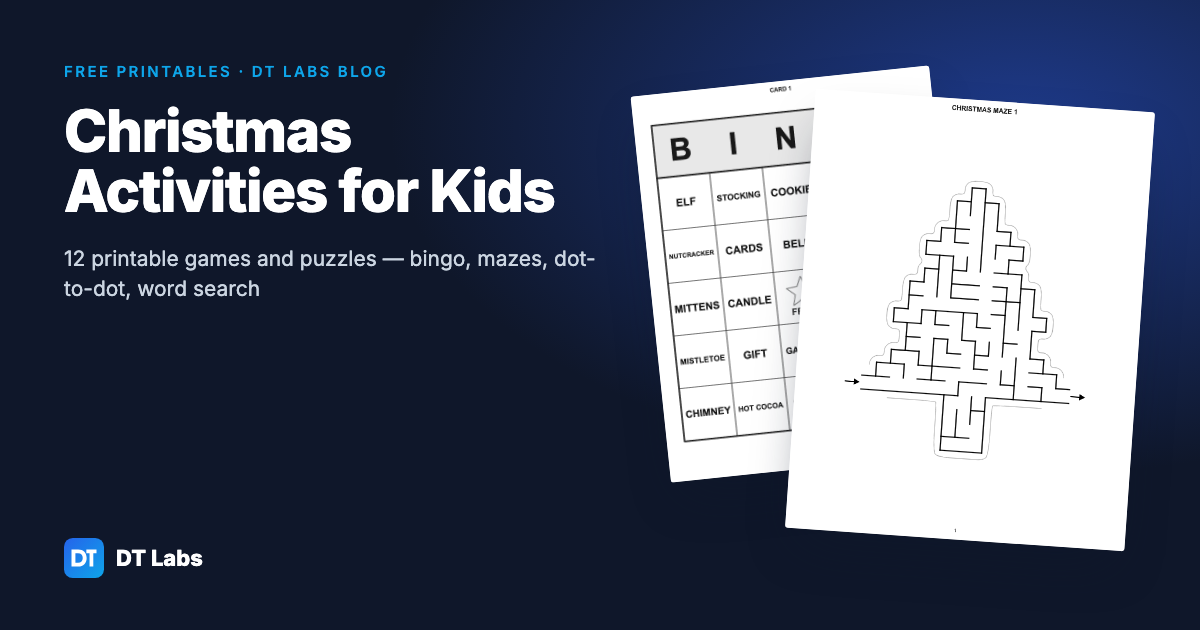
Christmas Activities for Kids: 12 Printable Games and Puzzles
Twelve Christmas activities for kids at home and in the classroom — word searches, bingo, tree and snowman mazes, dot-to-dots, crosswords and an advent puzzle calendar — with free printables and answers.
Nov 2, 2026 · 4 min read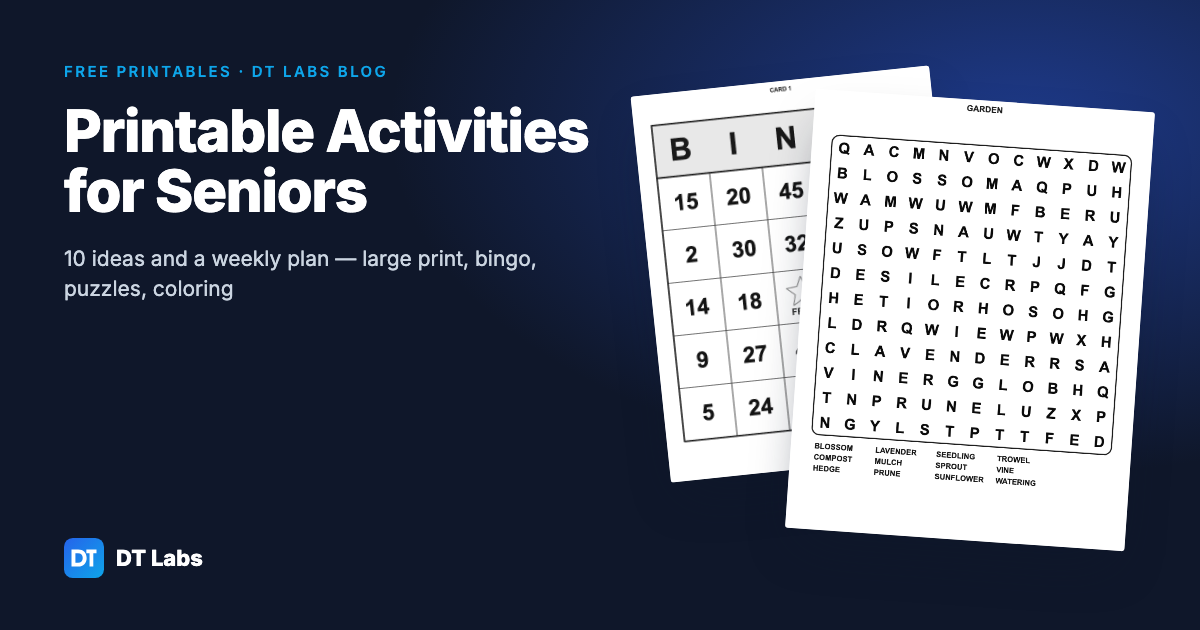
Printable Activities for Seniors: 10 Ideas and a Weekly Plan
Ten printable activities for seniors at home, in care homes and in community groups — large print word searches, bingo, easy sudoku, proverb cryptograms, crosswords and coloring — plus a simple weekly plan, all free to print.
Nov 2, 2026 · 4 min read