
How to Make a Cryptogram Book for KDP (Large Print or Regular)
Make a cryptogram book for Amazon KDP: public domain quotes, letter, symbol or number codes, difficulty and hints, large print, answers, trim size and price.
By Dau Le · · 5 min read
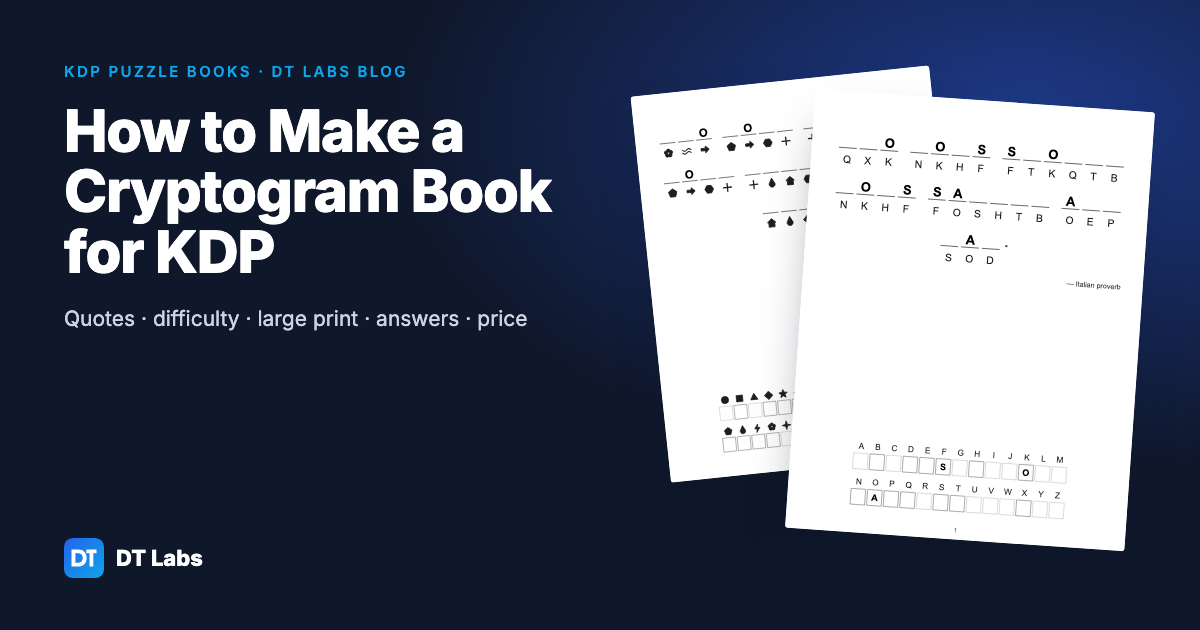
Cryptograms — also called cryptoquotes — are a favourite of puzzle-book buyers who like words more than numbers, and many of them are older readers who want large print. The puzzle itself is simple: a quote written in a letter-swap code. What makes a good cryptogram book is the quotes you choose, the right amount of help, a layout that leaves room to write, and an answer key that credits each quote. This guide covers how to make a cryptogram book for Amazon KDP, from quotes to price.
In short: use public domain quotes (proverbs and sayings, or classics published long ago) with their sources, choose letter, symbol or number codes, give more starting letters in easy puzzles and none in hard ones, use large print for older readers, put the decoded quotes and sources at the back, and check the page count against the printing cost before you set a price. You can try three levels on paper with our free printable cryptograms.
What do you need to make a cryptogram book?
A cryptogram maker that encodes each quote with its own code (no letter standing for itself), prints a key row for the solver's notes, and makes the answer pages; a list of quotes you are allowed to use; a cover sized to your page count; and a free KDP account. The DT Labs cryptogram maker has a built-in library of public domain proverbs, classic sayings with sources, King James Bible verses and folk riddles, and accepts your own list.
Where do you get quotes you can use?
This is the part to get right first. Short quotes can still be protected by copyright, and a quote from a living author, a recent film or a song lyric does not belong in a book you sell.
Safer sources:
- Traditional proverbs and sayings from around the world.
- Classic quotes from works published long ago — the DT Labs library uses quotes dated before 1930, with the source printed.
- Public domain texts such as the King James Version of the Bible.
- Your own words — sayings, riddles or facts you write yourself.
If you are not sure a quote is free to use, leave it out. Copyright rules differ by country, so check them for the markets you sell in.
Letter, symbol or number codes?
All three use the same idea — each letter is swapped for something else, the same way throughout one puzzle — but they look and feel different on the page.
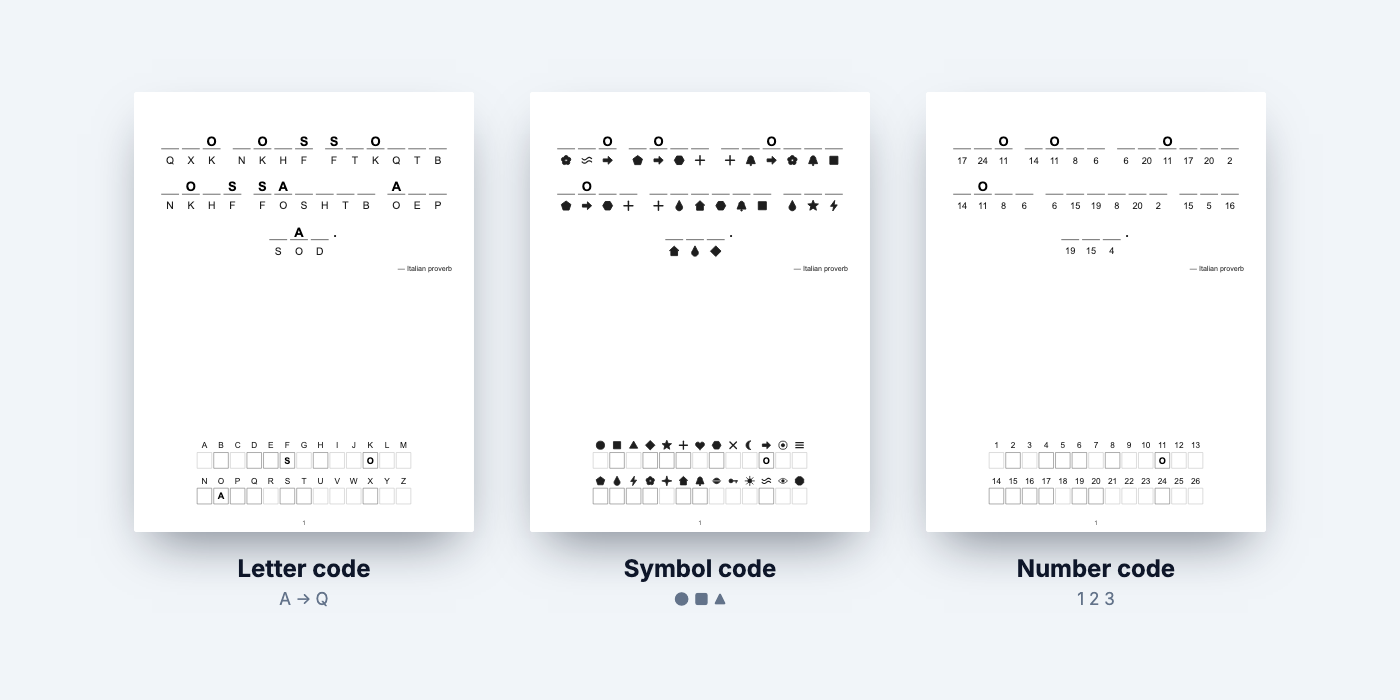
- Letter code (A → Q): the classic cryptoquote. Familiar to most solvers.
- Symbol code (● ■ ▲): looks like a secret message; popular with children and in gift books.
- Number code (1 2 3): easy to read in large print and good for classrooms.
A book can mix them by section, but most stick to one so the solver settles into a rhythm.
How do you set the difficulty?
Difficulty comes from two things: the quote and the help you give.
- Starting letters: easy puzzles give about three letters, medium one, hard none.
- Quote length and variety: short quotes with few different letters are easier; long quotes with rare letters (J, Q, X, Z) are harder.
- A letter-count hint: showing how often each code letter appears helps solvers spot E and T.
Ramp the book from easy to hard so the first pages build confidence. A key row under each puzzle — the alphabet with a box under each letter — lets solvers record what they have worked out.
Large print or regular?
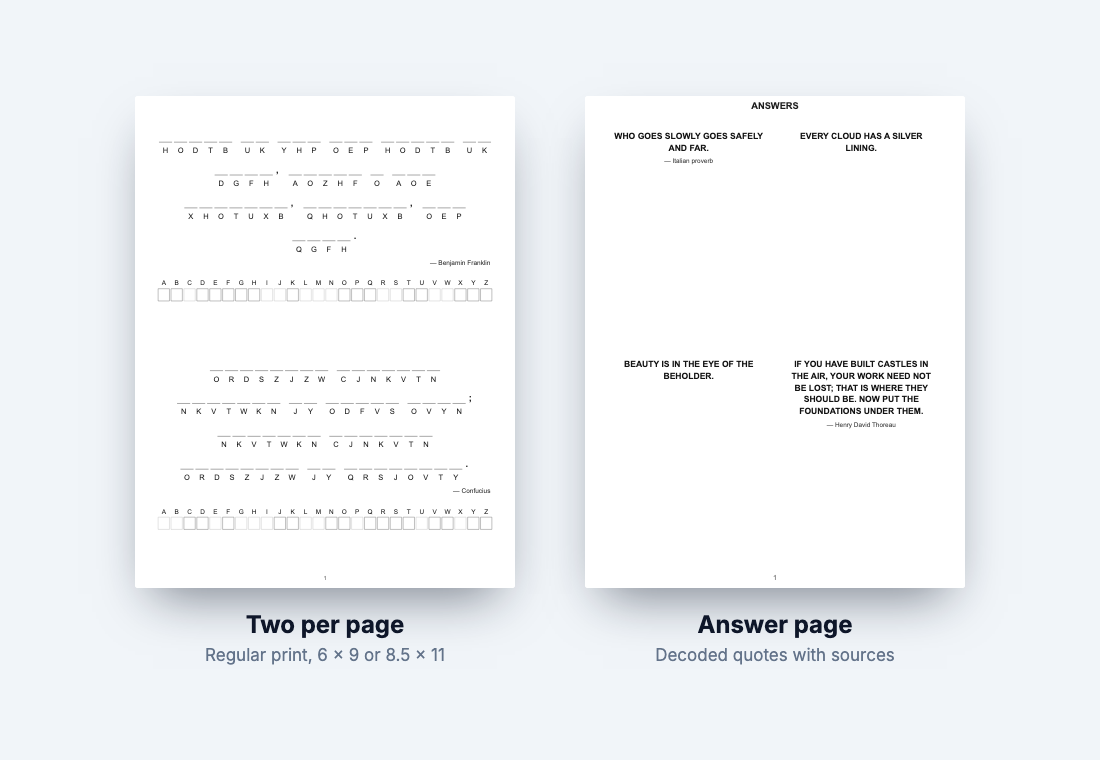
- Large print: one puzzle per 8.5 × 11 in page, big letters and wide blanks to write above each code letter. Suits older readers — the same reasons as in large print word search for seniors.
- Regular: two puzzles per page on 6 × 9 in or 8.5 × 11 in. Uses shorter quotes so both fit.
How do you add the answers?
Put the decoded quotes at the back, four to nine to a page, numbered like the puzzles, with the author or source under each. The source line is part of what makes a cryptogram book feel finished, and it shows readers where the quote came from.
What trim size, page count and price work for a cryptogram book?
Two example formats, priced with Amazon.com's 2026 printing costs (black ink):
| Book | Pages | Printing | Royalty at lower price | Royalty at $9.99 |
|---|---|---|---|---|
| Large print, 8.5 × 11 in, 100 puzzles 1 per page, answers 4 per page | about 128 | about $3.18 | about $1.32 at $8.99 | about $2.82 |
| Regular, 6 × 9 in, 150 puzzles 2 per page, answers 9 per page | about 95 | $2.30 | about $1.70 at $7.99 | about $3.69 |
Below $9.99, KDP pays 50% of the list price instead of 60% — see KDP paperback royalties and the 50% rule. These are per-copy royalties, not a sales forecast; check your own numbers in the royalty calculator. See trim size for puzzle books for the trade-offs, and size the cover with the spine width calculator.
How do you publish the cryptogram book on KDP?
- Title and subtitle: include both names and the format — for example "Large Print Cryptograms: 100 Cryptoquote Puzzles of Proverbs and Classic Sayings, with Answers".
- Low-content option or ISBN: puzzle books can be published as low-content, which makes the ISBN optional (but rules out Expanded Distribution).
- Upload the interior and cover PDFs and fix anything the previewer flags.
- Order a proof and solve an easy and a hard puzzle.
- Description: say where the quotes come from, the code type, the number of puzzles, the print size and that answers with sources are included.
Try the levels on paper first
Our free printable cryptograms page has 30 large print puzzles — easy, medium and hard — built from public domain proverbs and sayings, with the decoded quotes and sources at the back.
When you are ready, the cryptogram maker makes letter, symbol and number cryptograms from its public domain library or your own quotes, with three hint levels, an easy-to-hard ramp, key rows and letter-count hints, one to four puzzles per page, and exports a KDP-ready PDF with answers. It is free, and exports carry a commercial licence.
Cryptogram book checklist
- Quotes you are free to use, with sources
- One code type (letter, symbol or number) per book or section
- Easy to hard: more starting letters early, none at the end
- Key row under each puzzle
- Large print for older readers, one per page
- Decoded quotes and sources at the back
- Page count and printing cost checked against the price
Frequently asked questions
What is the difference between a cryptogram and a cryptoquote?
A cryptoquote is a cryptogram whose hidden text is a quotation. Most cryptogram books are cryptoquotes, so it helps to use both words.
Can I use famous quotes in a cryptogram book?
Only quotes you are free to use. Traditional proverbs and quotes from works published long ago are usually public domain; quotes from living authors, recent films or songs usually are not. If unsure, leave it out.
How many hints should a cryptogram give?
About three starting letters for easy puzzles, one for medium and none for hard.
Are large print cryptograms one per page?
Usually yes: one puzzle per 8.5 × 11 in page, with room to write above each code letter.
Do cryptogram books need answers?
Yes. Put the decoded quotes with their sources at the back, numbered like the puzzles.
Where can I get free printable cryptograms?
DT Labs has 30 free large print cryptograms with answers at dtlabs.app/printable-cryptograms.
Christmas Activities for Seniors: Large Print Puzzles, Bingo and Carols
Christmas activities for seniors at home, in care homes and in church groups — large print Christmas word searches, bingo, carol cryptograms, crosswords and ornament coloring pages, with free printables and answers.
Nov 2, 2026 · 4 min read
Christmas Activities for Kids: 12 Printable Games and Puzzles
Twelve Christmas activities for kids at home and in the classroom — word searches, bingo, tree and snowman mazes, dot-to-dots, crosswords and an advent puzzle calendar — with free printables and answers.
Nov 2, 2026 · 4 min read
Printable Activities for Seniors: 10 Ideas and a Weekly Plan
Ten printable activities for seniors at home, in care homes and in community groups — large print word searches, bingo, easy sudoku, proverb cryptograms, crosswords and coloring — plus a simple weekly plan, all free to print.
Nov 2, 2026 · 4 min read