
How to Make a Bimaru Puzzle Book for KDP (Hidden Fleet Puzzles)
Make a Bimaru puzzle book for Amazon KDP: grid sizes and fleets, given squares, logic-only puzzles, the instructions page, answers, trim size and price.
By Dau Le · · 5 min read
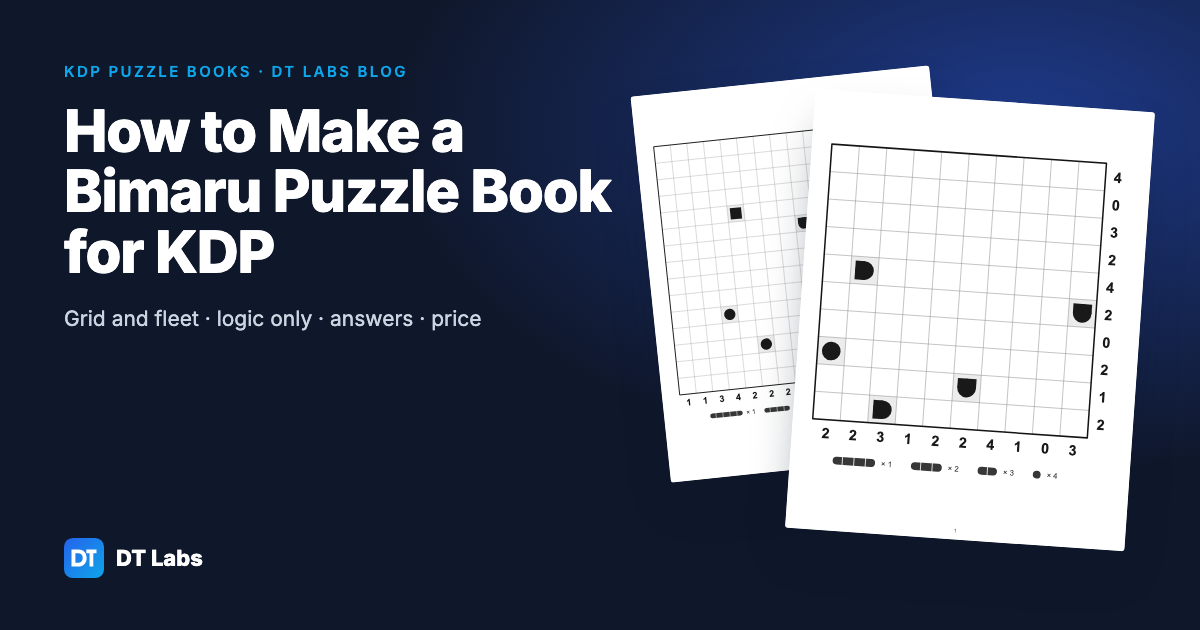
Bimaru is a hidden fleet puzzle: a fleet of ships is hidden in a grid, and numbers beside each row and column say how many of its squares are ship squares. It is less common in bookshops than sudoku or nonograms — which is part of its appeal for a puzzle-book publisher — and its solvers are logic-puzzle fans who notice when a grid needs guessing. This guide covers how to make a Bimaru puzzle book for Amazon KDP: grid and fleet, given squares, logic-only puzzles, answers, trim size and price.
In short: choose grid sizes with a fleet that fits each, print the fleet under every grid, give enough starting squares for the difficulty, make sure every puzzle can be solved by logic alone, put the answers at the back, and check the page count against the printing cost before you set a price. You can try three sizes on paper with our free printable Bimaru puzzles.
What do you need to make a Bimaru puzzle book?
A Bimaru generator that hides a fleet, counts each row and column, chooses the given squares and checks the puzzle can be solved without guessing; a cover sized to your page count; and a free KDP account. The DT Labs Bimaru puzzle generator does this in your browser and makes the answer pages.
How do you play Bimaru?
- A fleet is hidden in the grid; the fleet is drawn under each puzzle.
- Ships lie straight, across or down, and never touch each other — not even at a corner.
- The number beside each row and under each column is how many of its squares are ship squares.
- Some squares are given: a circle is a one-square ship, a rounded end is the end of a ship, a square is the middle of a ship, and a wave is open water.
Put these rules, with a drawing of each given-square symbol, on the instructions page.
Which grid sizes and fleets should you use?
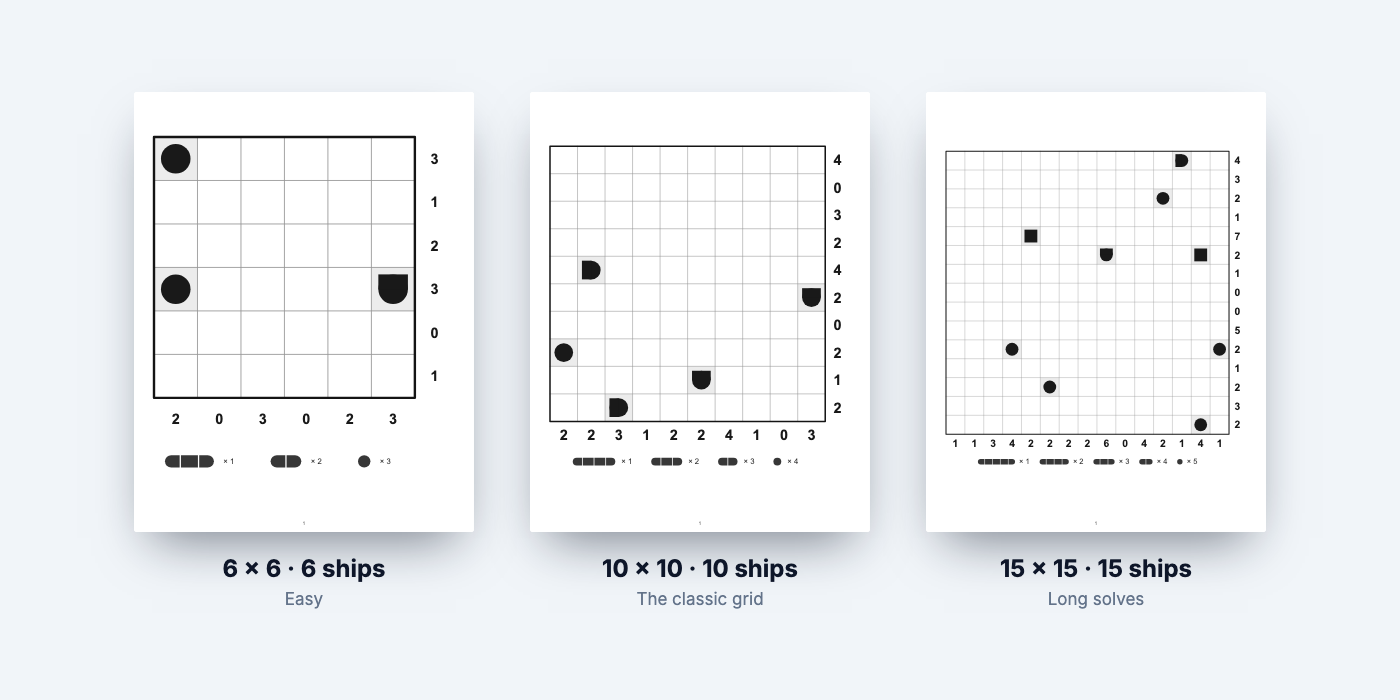
Each grid size needs a fleet sized to it. The usual ones:
| Grid | Fleet (ship length × how many) | Suits |
|---|---|---|
| 6 × 6 | 3 × 1, 2 × 2, 1 × 3 (6 ships) | Beginners |
| 8 × 8 | 4 × 1, 3 × 2, 2 × 2, 1 × 3 (8 ships) | Most solvers |
| 10 × 10 | 4 × 1, 3 × 2, 2 × 3, 1 × 4 (10 ships) | The classic size |
| 12 × 12 | 5 × 1, 4 × 1, 3 × 2, 2 × 3, 1 × 4 (11 ships) | Experienced solvers |
| 15 × 15 | 5 × 1, 4 × 2, 3 × 3, 2 × 4, 1 × 5 (15 ships) | Long solves |
Ten by ten with the ten-ship fleet is what most Bimaru solvers know. A book can ramp from 6 × 6 to 10 × 10, or stay at one size and ramp the difficulty.
How do given squares set the difficulty?
- Easy: many given squares; the puzzle can be finished by counting and the shapes of the ships.
- Medium: fewer given squares; the solver must also reason about where each ship can still fit.
- Hard: very few given squares; long chains of fleet reasoning — "where can the largest ship still go?"
A good first move is the same at every level: rows and columns with a count of 0 are all water, and every square around a given ship square is water too.
Why must every Bimaru be solvable by logic alone?
If the counts and given squares fit two different fleets, the solver has to guess. A generator should solve each puzzle with a logic solver that never guesses — counts, the no-touching rule, the given squares and where each remaining ship can fit — and add given squares until that solver finishes the grid. That also proves there is only one solution. Then remove any given square the solver did not need, so the puzzle is not easier than its label.
How do you add the answers?
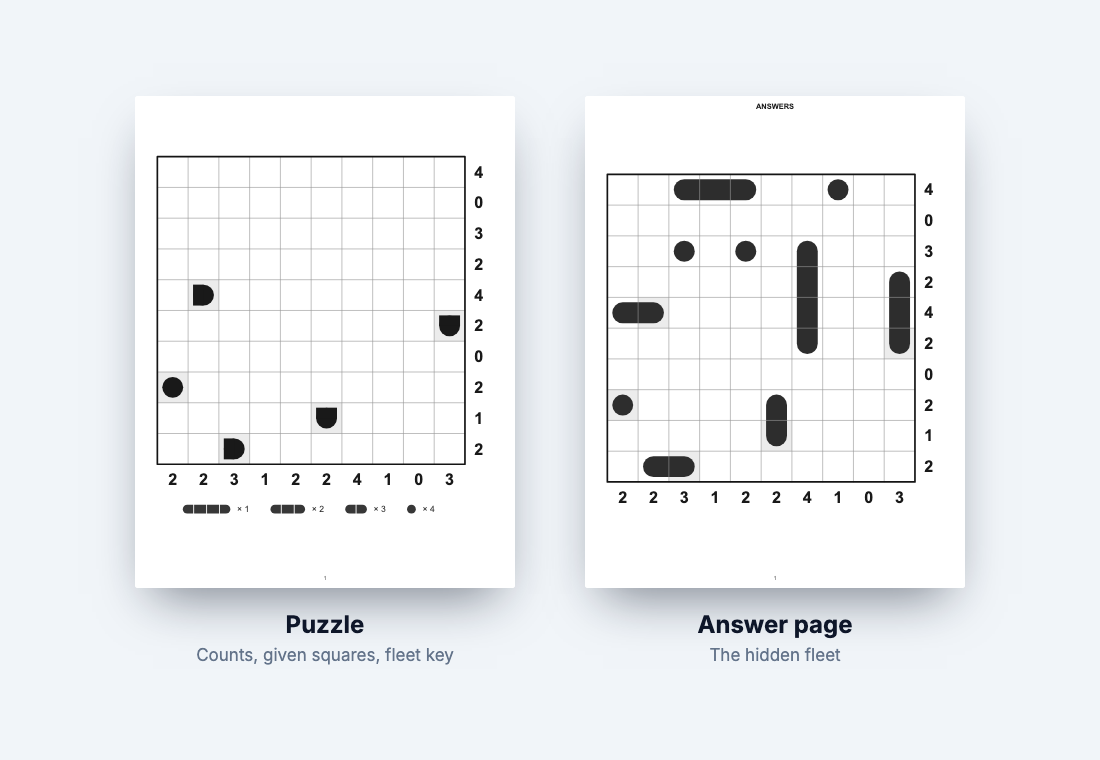
Put the solved grids at the back — the fleet drawn in, water left blank — four to six per page, numbered like the puzzles.
What trim size, page count and price work for a Bimaru book?
Counts sit along two edges and the fleet goes under the grid, so leave room. Two example formats, priced with Amazon.com's 2026 printing costs (black ink):
| Book | Pages | Printing | Royalty at lower price | Royalty at $9.99 |
|---|---|---|---|---|
| 8.5 × 11 in, 50 puzzles 1 per page, answers 4 per page | about 66 | $2.84 | about $1.16 at $7.99 | about $3.15 |
| 6 × 9 in, 100 puzzles 2 per page, answers 6 per page | about 70 | $2.30 | about $1.70 at $7.99 | about $3.69 |
Below $9.99, KDP pays 50% of the list price instead of 60% — see KDP paperback royalties and the 50% rule. These are per-copy royalties, not a sales forecast; check your own numbers in the royalty calculator and size the cover with the spine width calculator.
How do you publish the Bimaru book on KDP?
- Title and subtitle: use the puzzle's generic names — Bimaru, hidden fleet puzzles, logic puzzles — and say the sizes. Do not use the names of board games or other brands in the title, subtitle or keywords.
- Low-content option or ISBN: puzzle books can be published as low-content, which makes the ISBN optional (but rules out Expanded Distribution).
- Upload the interior and cover PDFs and fix anything the previewer flags.
- Order a proof and solve one puzzle of each size.
- Description: give the grid sizes and fleets, the number of puzzles, that each is solvable by logic alone and that answers are included.
Bimaru buyers often like other grid logic puzzles too — see how to make a nonogram book.
Try the sizes on paper first
Our free printable Bimaru puzzles page has 30 puzzles — easy 6 × 6, medium 8 × 8 and hard 10 × 10 — each solvable by logic alone, with answers at the back. For picture logic, see our free printable nonograms.
When you are ready, the Bimaru puzzle generator makes puzzles in 6 × 6, 8 × 8, 10 × 10, 12 × 12 and 15 × 15, each with a fleet sized to the grid, in three difficulty levels with an easy-to-hard ramp and one to six puzzles per page, and exports a KDP-ready PDF with solutions. It is free, and exports carry a commercial licence.
Bimaru book checklist
- Grid sizes chosen, each with a fleet that fits
- Fleet drawn under every puzzle
- Given-square symbols explained on the instructions page
- Every puzzle solvable by logic alone
- Generic puzzle names only — no board-game or brand names
- Answers at the back, numbered like the puzzles
- Page count and printing cost checked against the price
Frequently asked questions
What is a Bimaru puzzle?
A logic puzzle where a fleet of ships is hidden in a grid. Numbers beside each row and column say how many ship squares it has, ships never touch, and a few squares are given.
What fleet does a 10 × 10 Bimaru use?
Usually one ship of 4 squares, two of 3, three of 2 and four of 1 — ten ships and 20 ship squares in all.
What size Bimaru is good for beginners?
6 × 6 with six ships and plenty of given squares. Move to 8 × 8 and then the classic 10 × 10.
Can every Bimaru be solved without guessing?
A well-made one can. Check each puzzle with a logic solver that never guesses; if it finishes the grid, the puzzle has exactly one solution.
How many Bimaru puzzles fit on a page?
One per page on 8.5 × 11 in for 10 × 10 and larger, or two per page on 6 × 9 in for 6 × 6 to 10 × 10.
Where can I get free printable Bimaru puzzles?
DT Labs has 30 free printable Bimaru puzzles with answers at dtlabs.app/printable-bimaru, in 6 × 6, 8 × 8 and 10 × 10.
Christmas Activities for Seniors: Large Print Puzzles, Bingo and Carols
Christmas activities for seniors at home, in care homes and in church groups — large print Christmas word searches, bingo, carol cryptograms, crosswords and ornament coloring pages, with free printables and answers.
Nov 2, 2026 · 4 min read
Christmas Activities for Kids: 12 Printable Games and Puzzles
Twelve Christmas activities for kids at home and in the classroom — word searches, bingo, tree and snowman mazes, dot-to-dots, crosswords and an advent puzzle calendar — with free printables and answers.
Nov 2, 2026 · 4 min read
Printable Activities for Seniors: 10 Ideas and a Weekly Plan
Ten printable activities for seniors at home, in care homes and in community groups — large print word searches, bingo, easy sudoku, proverb cryptograms, crosswords and coloring — plus a simple weekly plan, all free to print.
Nov 2, 2026 · 4 min read