
How to Make a Nonogram Book for KDP (Picture Logic Puzzles)
Make a nonogram book for Amazon KDP: grid sizes by reader, logic-only puzzles, choosing pictures, two-colour nonograms, answer pages, trim size and price.
By Dau Le · · 5 min read
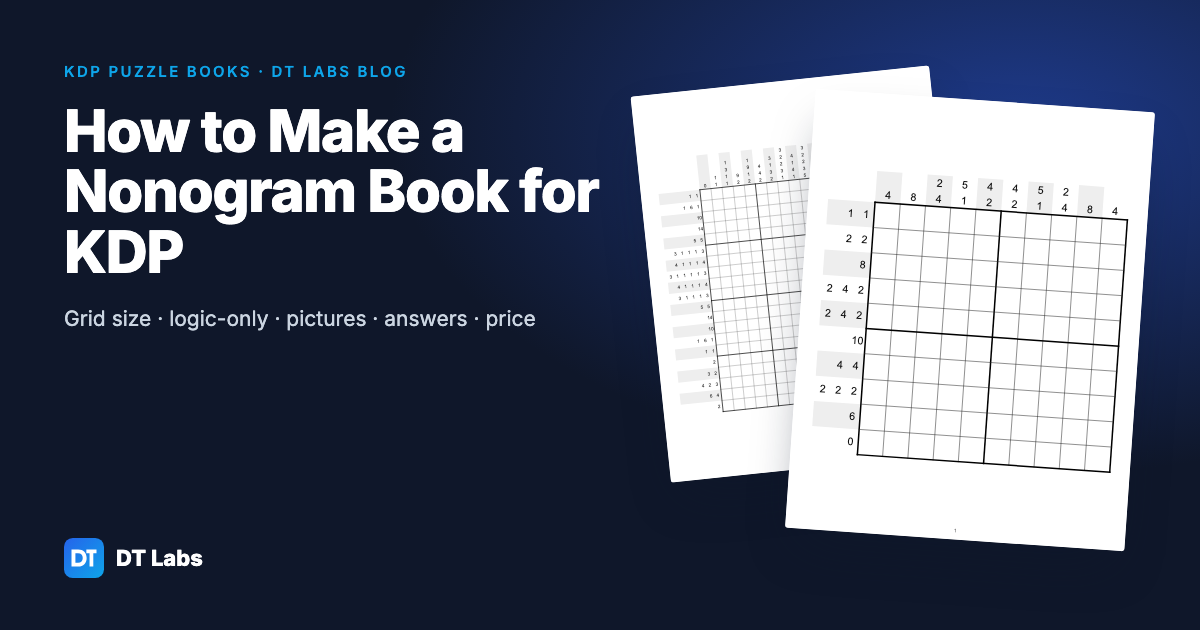
Nonograms — also sold as picross, griddlers or hanjie — have a loyal audience, and that audience is strict. A nonogram that cannot be finished without guessing gets called out in reviews, and so does a picture that turns out to be an unrecognisable blob. This guide covers how to make a nonogram book for Amazon KDP: grid size, logic-only puzzles, choosing pictures, two-colour nonograms, answers, trim size and price.
In short: pick grid sizes for your reader, make sure every puzzle can be solved by logic alone, use clear pictures with one main subject, put the finished pictures at the back, and check the page count against the printing cost before you set a price. You can try three sizes on paper with our free printable nonograms.
What do you need to make a nonogram book?
A nonogram maker that turns pictures into clue numbers and proves each puzzle can be solved without guessing; a set of pictures; a cover sized to your page count; and a free KDP account. The DT Labs nonogram maker runs a line solver on every puzzle before you see it and comes with 62 built-in pictures in six themes — animals, food, things, holidays, nature and vehicles.
Which grid size suits your reader?
The grid size decides both difficulty and how long one puzzle takes.
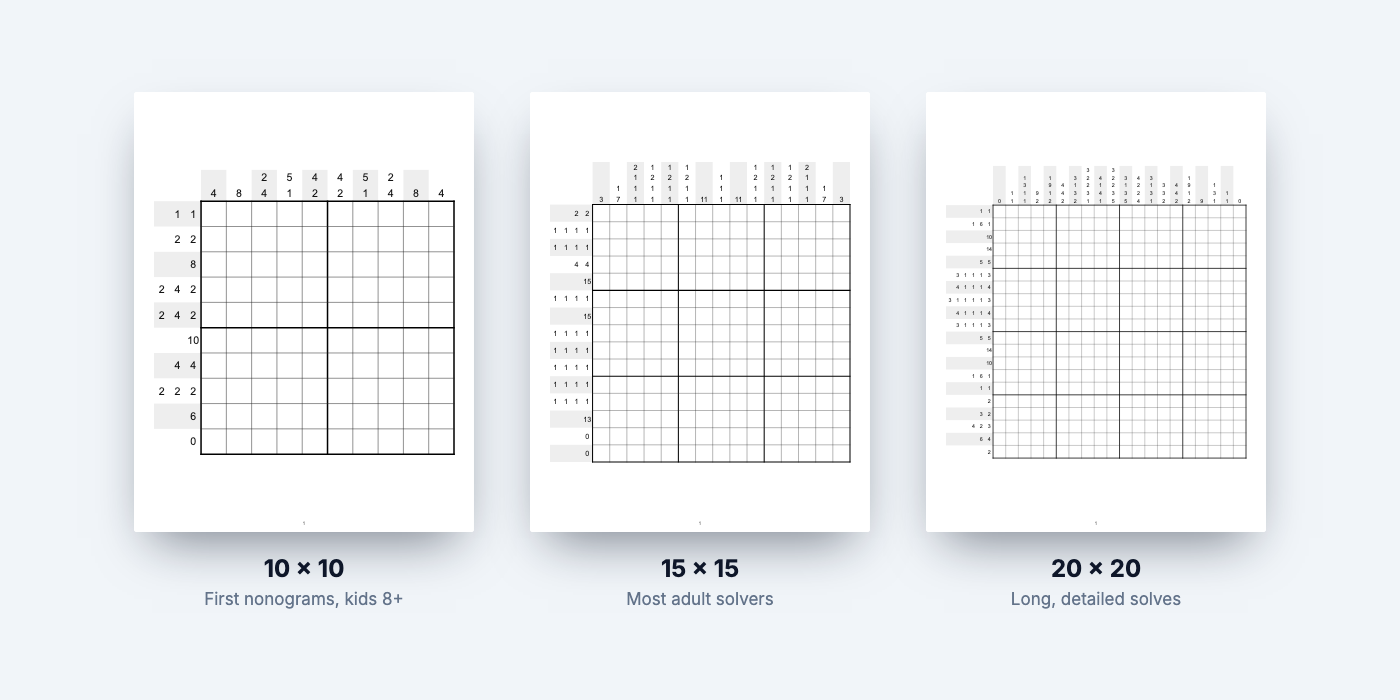
| Grid | Reader | Time per puzzle |
|---|---|---|
| 10 × 10 | First nonograms, children around 8 and up | 5–15 minutes |
| 15 × 15 | Most adult solvers | 20–40 minutes |
| 20 × 20 and 25 × 25 | Experienced solvers | an hour or more |
The times are rough guides. Rectangular grids (10 wide × 15 tall, 20 wide × 15 tall and so on) fit tall or wide pictures better than squares. Many books ramp up: start with 10 × 10 and finish with 20 × 20.
Why must every nonogram be solvable by logic?
A nonogram's clues can fit more than one picture, or fit one picture only if the solver guesses. Both make a bad puzzle: the first has two "right" answers, and the second breaks the promise of a logic puzzle.
A line solver checks this. It works the way a person does — one row or column at a time, marking squares that must be filled or must be empty — and the puzzle is kept only if that process fills the whole grid. If a picture needs a few squares changed to become solvable, a good maker tells you how many, so you can decide whether the picture still looks right.
How do you choose good pictures?
- One main subject. A cat, a teapot, a sailboat. Scenes with many small parts turn into noise at 15 × 15.
- Bold outlines and solid areas. Nonograms reward shapes with clear blocks of shading.
- Your own images or drawings. Besides the library, you can upload a high-contrast image or draw a picture square by square. Use only images you made or have the right to use — no characters or logos.
- Name the picture on the answer page, not the puzzle page, so the surprise is kept.
What about two-colour nonograms?
Two-colour nonograms give each clue number a colour; blocks of different colours may touch. They make richer pictures and suit experienced solvers.
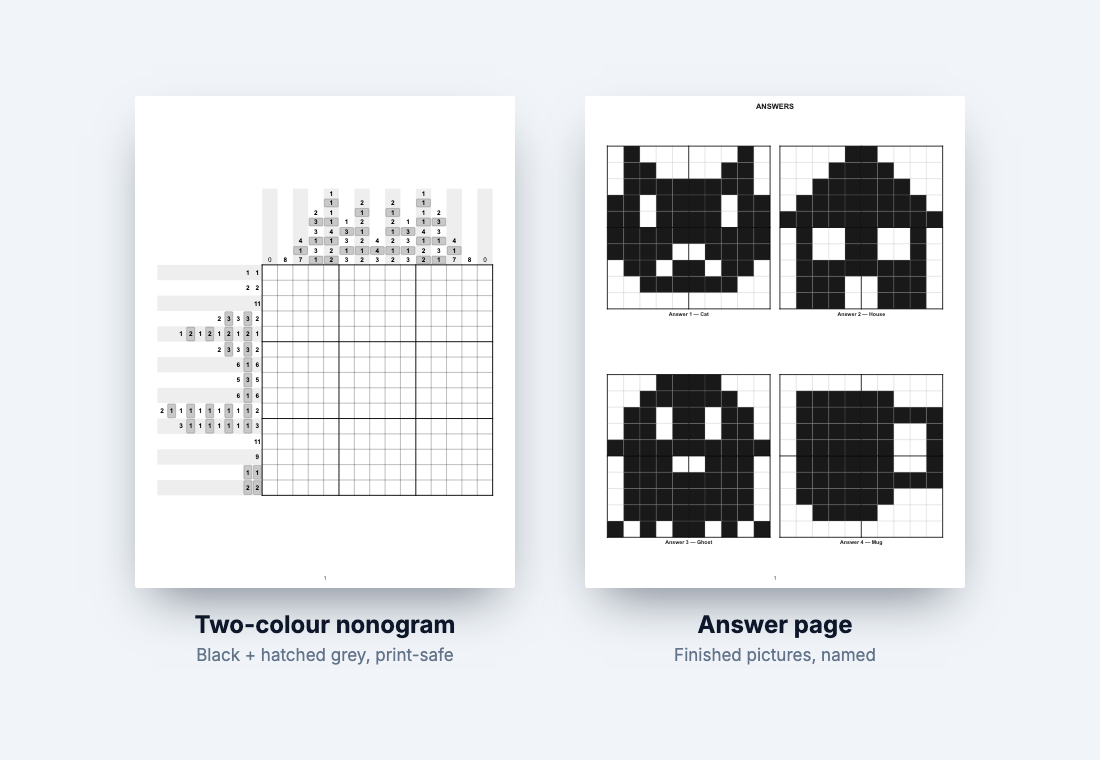
For a black-ink paperback, use a print-safe pair — black and a hatched grey — so the two colours are clear without colour printing. Colour palettes suit printables or premium colour books.
How do you add the answers?
Put the finished pictures at the back, four to a page for 10 × 10 or 15 × 15, labelled with the puzzle number and the picture name. Because the answers come from the same grid as the clues, they always match.
What trim size, page count and price work for a nonogram book?
Clue numbers along two edges take room, so 15 × 15 and larger grids need a full 8.5 × 11 in page. Small grids can go two to a page on 6 × 9 in. Two example formats, priced with Amazon.com's 2026 printing costs (black ink):
| Book | Pages | Printing | Royalty at lower price | Royalty at $9.99 |
|---|---|---|---|---|
| 8.5 × 11 in, 50 nonograms 1 per page, answers 4 per page | about 66 | $2.84 | about $1.16 at $7.99 | about $3.15 |
| 6 × 9 in, 100 small nonograms 2 per page, answers 6 per page | about 70 | $2.30 | about $1.70 at $7.99 | about $3.69 |
Below $9.99, KDP pays 50% of the list price instead of 60% — see KDP paperback royalties and the 50% rule. These are per-copy royalties, not a sales forecast; check your own numbers in the royalty calculator. For which trim suits which grid, see trim size for puzzle books, and size the cover with the spine width calculator.
How do you publish the nonogram book on KDP?
- Title and subtitle: use the names solvers search for — for example "Nonogram Puzzle Book: 50 Picture Logic Puzzles (Picross / Griddlers), 10×10 to 20×20, with Solutions".
- Low-content option or ISBN: puzzle books can be published as low-content, which makes the ISBN optional (but rules out Expanded Distribution).
- Upload the interior and cover PDFs and fix anything the previewer flags.
- Order a proof and solve one puzzle of each size.
- Description: give the grid sizes, the number of puzzles, that every puzzle is solvable by logic alone and that the finished pictures are included.
Ramp, layout and answer placement work the same way as in a sudoku book — see how to make a sudoku book for KDP.
Try the sizes on paper first
Our free printable nonograms page has 30 puzzles — easy 10 × 10, medium 15 × 15 and hard 20 × 20 — each checked by a logic-only solver, with the finished pictures at the back. If your readers like grid logic, there are also free printable Bimaru puzzles.
When you are ready, the nonogram maker makes one- and two-colour nonograms from 62 built-in pictures, simple shapes, your own images or your own drawings, in square and rectangular grids from 10 × 10 to 25 × 25, and exports a KDP-ready PDF with the finished pictures. It is free, and exports carry a commercial licence.
Nonogram book checklist
- Grid sizes chosen for one audience, named in the subtitle
- Every puzzle checked by a logic-only solver
- Clear pictures with one main subject, no characters or logos
- Print-safe colours for a black-ink book
- Finished pictures at the back, numbered and named
- Page count and printing cost checked against the price
- Proof copy: one puzzle of each size solved
Frequently asked questions
What is the difference between a nonogram, picross and griddlers?
None — they are names for the same picture logic puzzle. Using all three in a subtitle helps buyers who search for any of them.
What size nonogram is good for beginners?
10 × 10. Most adult solvers enjoy 15 × 15, and 20 × 20 or larger suits experienced solvers.
How do I know a nonogram has only one solution?
Check it with a line solver that uses logic only. If that solver can fill the whole grid, the puzzle has exactly one solution and needs no guessing.
Can I make nonograms from my own pictures?
Yes. The DT Labs nonogram maker can turn a high-contrast image you own into a nonogram, or you can draw one square by square.
What trim size is good for a nonogram book?
8.5 × 11 in for 15 × 15 grids and larger, one per page. Small 10 × 10 grids can go two to a page on 6 × 9 in.
Where can I get free printable nonograms?
DT Labs has 30 free printable nonograms in 10 × 10, 15 × 15 and 20 × 20 at dtlabs.app/printable-nonograms, with the finished pictures as answers.
Christmas Activities for Seniors: Large Print Puzzles, Bingo and Carols
Christmas activities for seniors at home, in care homes and in church groups — large print Christmas word searches, bingo, carol cryptograms, crosswords and ornament coloring pages, with free printables and answers.
Nov 2, 2026 · 4 min read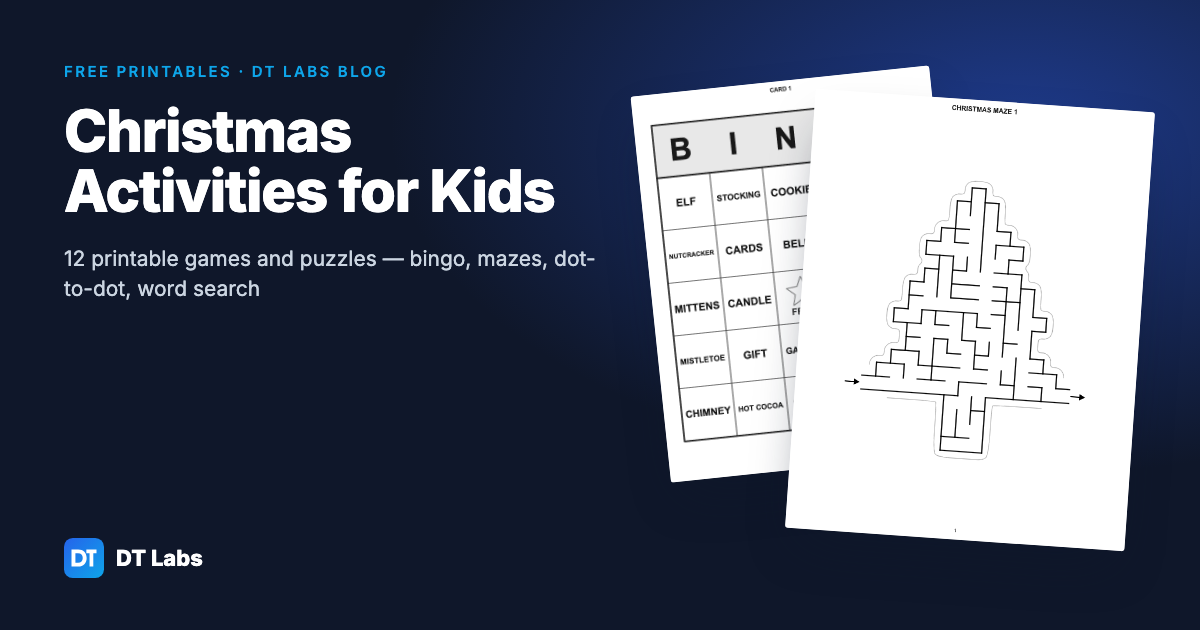
Christmas Activities for Kids: 12 Printable Games and Puzzles
Twelve Christmas activities for kids at home and in the classroom — word searches, bingo, tree and snowman mazes, dot-to-dots, crosswords and an advent puzzle calendar — with free printables and answers.
Nov 2, 2026 · 4 min read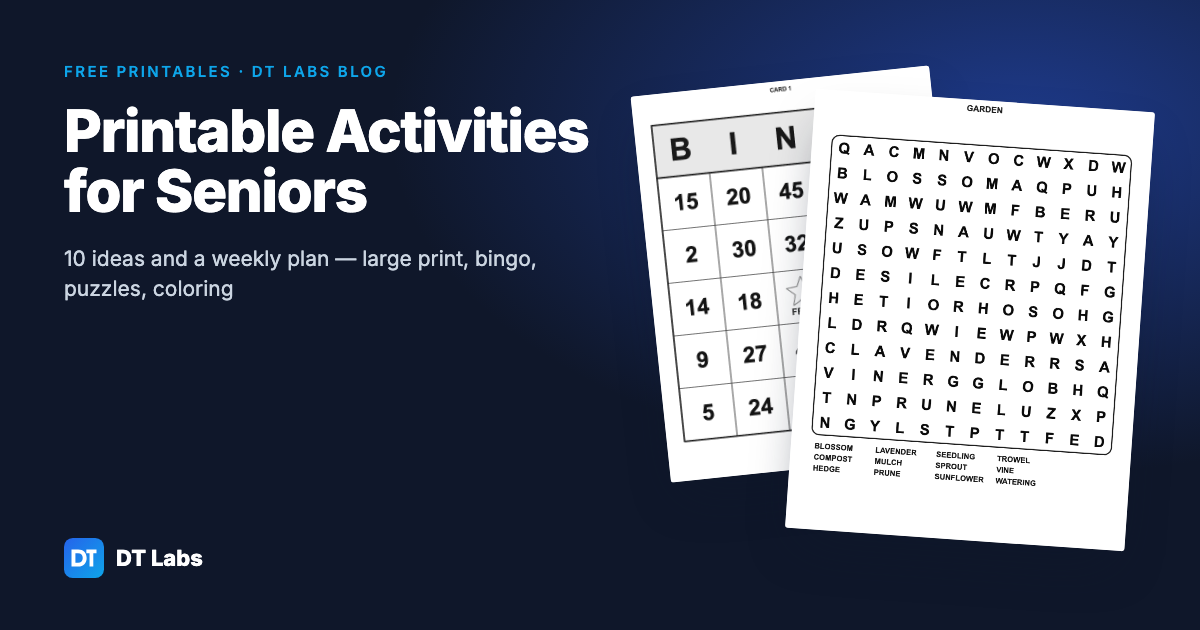
Printable Activities for Seniors: 10 Ideas and a Weekly Plan
Ten printable activities for seniors at home, in care homes and in community groups — large print word searches, bingo, easy sudoku, proverb cryptograms, crosswords and coloring — plus a simple weekly plan, all free to print.
Nov 2, 2026 · 4 min read