
Lesson 22 of 47 · 9 min read
Choosing a trim size
See how page size changes your layout, page count and royalty, using 100 sudoku built four ways.
Trim size is the width and height of your finished book. It affects how your pages look, how many pages you need and what each copy costs to print. It also comes early, because the interior and cover are both built to it, so choose before you start.
For a puzzle or activity book, the useful question is: how much room does one page of my book need?
The sizes KDP offers
KDP's trim size page lists these paperback sizes, in inches:
5 × 8, 5.06 × 7.81, 5.25 × 8, 5.5 × 8.5, 6 × 9, 6.14 × 9.21, 6.69 × 9.61, 7 × 10, 7.44 × 9.69, 7.5 × 9.25, 8 × 10, 8.25 × 6, 8.25 × 8.25, 8.5 × 8.5, 8.5 × 11 and 8.27 × 11.69.
That list looks long, but you will use only a few. KDP notes that 6 × 9 is the most common size in the US. For puzzle, activity and planner books, the usual choice is between 6 × 9 and 8.5 × 11. Check the page itself for any changes.
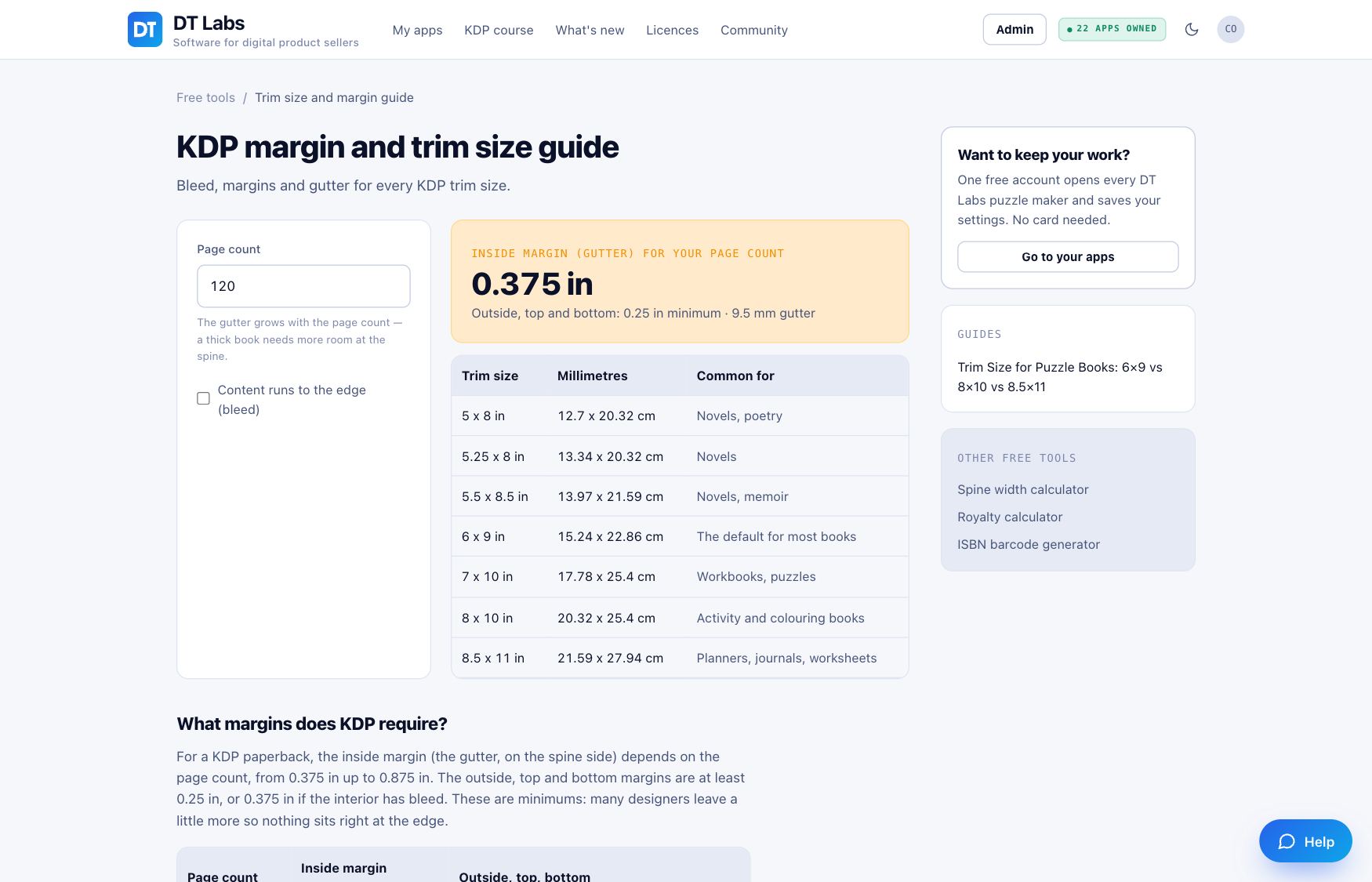
Our trim size guide shows common sizes in inches and centimetres, along with what each one is often used for.
Regular and large trim
There is one line that matters for money. KDP treats a book as large trim if it is wider than 6.12 in or taller than 9 in. Large trim costs more to print.
So 6 × 9 is regular, and 7 × 10, 8 × 10 and 8.5 × 11 are all large. Even a shorter book like 8.25 × 6 is large, because of its width. This is why the royalty calculator asks only for Regular or Large.
Page limits
Limits also vary. Black ink on white paper runs from 24 to 828 pages at most sizes, but 8.5 × 8.5 and 8.5 × 11 stop at 590. Standard colour runs from 72 to 600 pages. For a first puzzle book, you are unlikely to reach these, but a thick collection might.
A worked example: 100 sudoku, four ways
Here is the same content, 100 sudoku with 6 answers per page at the back, built four ways. We counted the pages as Sudoku Press does: title page, how-to-play page, puzzle pages, answer pages and one blank page if needed for an even total. Royalties are at $9.99, black ink, from the royalty calculator.
| Trim | Puzzles per page | Pages | Printing | Royalty at $9.99 |
|---|---|---|---|---|
| 6 × 9 in | 4 | 44 | $2.30 | $3.69 |
| 6 × 9 in | 1 | 120 | $2.44 | $3.55 |
| 8.5 × 11 in | 2 | 70 | $2.84 | $3.15 |
| 8.5 × 11 in | 1 | 120 | $3.04 | $2.95 |
The royalty column points to the first row, which is a trap. Four sudoku on a 6 × 9 page means small grids, and a 44-page book feels slight next to others in the same niche at that price. The buyer would have every reason to feel short-changed.
The other three are real choices, and each suits a different reader:
- 6 × 9, one per page: a comfortable book to carry, with a clear grid, and a thicker feel. Good for commuters and travel.
- 8.5 × 11, two per page: big grids and fewer pages. Costs a little more to print, and offers two puzzles on each page.
- 8.5 × 11, one per page: the biggest grids. This is the large print choice, and it costs 60 cents a copy more than the 6 × 9 version of the same length.
The right answer depends on your brief from the reviews lesson. If buyers complain about small print, those 60 cents are the price of solving their problem. If they want a book for the train, the bigger page works against them.
How to choose
Work through these in order:
- What does the reader do on the page? Writing, solving and tracing need room. Children need more room than adults.
- What do similar books use? Look at the size on the top ten books in your niche. A very different size can be a real advantage or a warning sign, and you should know which.
- What is the royalty at your likely price? Run regular and large in the calculator.
- Does your maker export it? The DT Labs puzzle makers export 6 × 9, 8.5 × 11, 8 × 10 and 8.5 × 8.5 for KDP paperbacks. Planner Plate exports the first three of those. If you want another size, you would need to build the interior elsewhere.
A useful detail: in the makers, turning on Large print on a 6 × 9 book moves it to 8.5 × 11 for you. A small page and large print do not go well together, so the app changes the size. Check your page count afterwards.
Make the choice early
Changing trim size later means rebuilding the interior and the cover. The page count usually changes too, and your royalty moves with it. So treat this as a decision, then write it down.
If you are unsure, print one page at the size you are thinking about. Cut it out and try to solve the puzzle or fill it in with a pencil. That takes five minutes and tells you more than any table.
Your task
- Find the size of the top ten books for your phrase and note the most common.
- Choose two possible trim sizes for your book.
- Work out the page count for each and run both in the royalty calculator.
- Print one sample page at each size and try it.
- Write down your chosen trim size. Everything in the next lessons depends on it.
— The DT Labs team