
Lesson 41 of 47 · 8 min read
Break-even ACOS: the one ad number that is yours
Work out the ACOS where a sale stops making money, before you spend anything.
Before you run an ad, work out one number: the ACOS at which a sale stops making you money. It takes two minutes, and it comes from your own book rather than from anyone's rule of thumb.
What ACOS means
ACOS stands for advertising cost of sale. Amazon works it out like this:
ACOS = ad spend ÷ ad sales × 100
If you spend $10 and the ads bring in $20 of book sales, your ACOS is 50%.
The catch is that "ad sales" means the list price of the books sold. You do not keep the list price. You keep your royalty, which is much smaller. So a figure that looks healthy can still be a loss.
Your break-even ACOS
break-even ACOS = royalty ÷ list price × 100
The royalty calculator shows this number for you. It is the percentage under "You earn per copy".
Here is our Garden Word Search book: 78 pages, black ink, large trim, at $9.99.
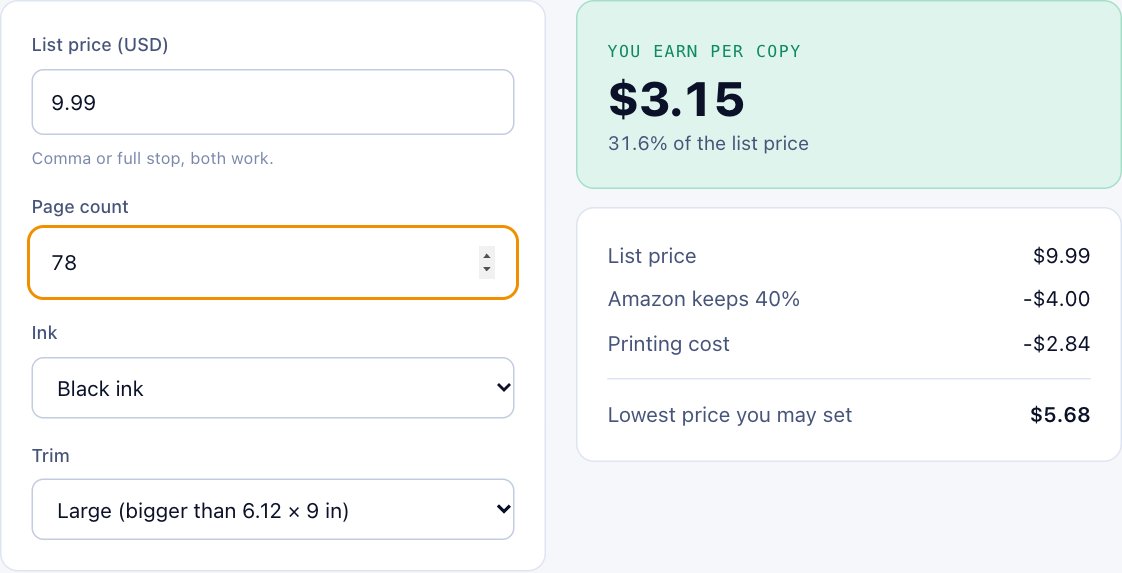
We earn $3.15 per copy. Before rounding that is $3.154, or 31.6% of the list price, which is what the calculator shows. Dividing the rounded $3.15 by hand gives 31.5%. So our break-even ACOS is 31.6%. Above that, each ad sale loses money. Below it, each ad sale makes some.
Why there is no universal target
Change the price of the same book and the answer moves a long way.
| List price | Royalty per copy | Break-even ACOS |
|---|---|---|
| $7.99 | $1.16 | 14.5% |
| $9.99 | $3.15 | 31.6% |
| $12.99 | $4.95 | 38.1% |
Look at the first two rows. Moving from $7.99 to $9.99 adds $2 to the price but nearly triples the royalty. On Amazon.com, KDP pays 50% of list price up to $9.98 and 60% from $9.99, so that small step crosses a line. See KDP's paperback royalty page for the current rates.
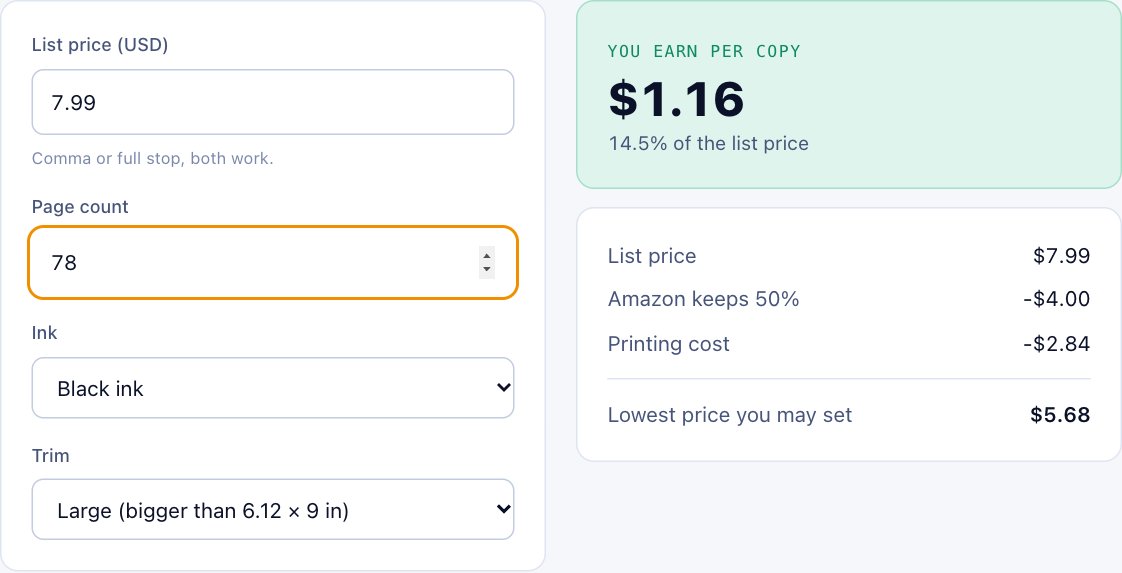
Be wary of any fixed "good ACOS" figure you read. It may be right for the book it came from and wrong for yours. A 30% ACOS is a small profit on our $9.99 book, and a clear loss at $7.99.
A worked example
These figures are made up to show the sum. They are not a forecast.
Suppose we spend $10 on 20 clicks and sell 2 copies at $9.99.
| Line | Amount |
|---|---|
| Ad sales | $19.98 |
| ACOS | 50% |
| Royalty earned (2 × $3.15) | $6.30 |
| Ad spend | $10.00 |
| Result on these sales | −$3.70 |
An ACOS of 50% is above our 31.6%, so we lost money, and the sum confirms it.
Now suppose the same $10 sells 4 copies.
| Line | Amount |
|---|---|
| Ad sales | $39.96 |
| ACOS | 25% |
| Royalty earned (4 × $3.15) | $12.60 |
| Ad spend | $10.00 |
| Result on these sales | +$2.60 |
An ACOS of 25% is below 31.6%, so we made a little.
What to do with the number
Use your break-even as a line, and read each ad against it:
- Well below break-even: this ad is working. It may be able to take more budget.
- Close to break-even: you are paying for visibility and little else. Decide whether that is what you want.
- Above break-even: you are losing money on every sale from this ad. You might accept that for a short, planned period to gather sales data on a new book, as long as you have set a limit in advance. Otherwise, lower the bid or stop the ad.
One caution: small numbers mislead. Two sales in a week tell you very little, so give an ad enough clicks to judge before you act on it. Later lessons cover how to decide.
Your task
- Open the royalty calculator and enter your own book's page count, ink and trim.
- Try prices either side of $9.99.
- Write down your chosen list price, your royalty and your break-even ACOS.
Keep that note. You will use it every time you open your ads dashboard.
— The DT Labs team